Last Updated on 03/09/2026 by KLB Editorial Team
Your CV isn’t the only thing potential employers may see when they search for you online.
Depending on your industry and the role you’re applying for, employers and recruiters may look at your LinkedIn profile, portfolio, professional social media accounts or other publicly available information when assessing candidates.
That doesn’t mean you need to turn your social media accounts into a constant job advertisement.
Instead, think of your online presence as an extension of your professional profile. What someone finds should support the impression your CV creates, not contradict it.
Here’s how to use social media to support your job search.
Table of Contents
Why Social Media Matters When You’re Looking for Work
Social media can work in your favour when you use it strategically.
LinkedIn is particularly useful for professional networking and connecting with recruiters, employers and people in your industry. Other platforms can also be valuable depending on your career.
For example:
- LinkedIn: Professional networking, job searching and showcasing experience
- Instagram: Useful for creative work, photography, design, beauty, marketing and other visual industries
- Facebook: Networking, professional groups and local job opportunities
- X: Following companies, industry conversations and professional communities
- GitHub: Demonstrating coding and development projects
- Behance: Showcasing design and creative work
You don’t need to be active on every platform. Focus on the platforms that make sense for your industry and the type of work you want.
The Dos: How to Use Social Media to Help Your Job Search
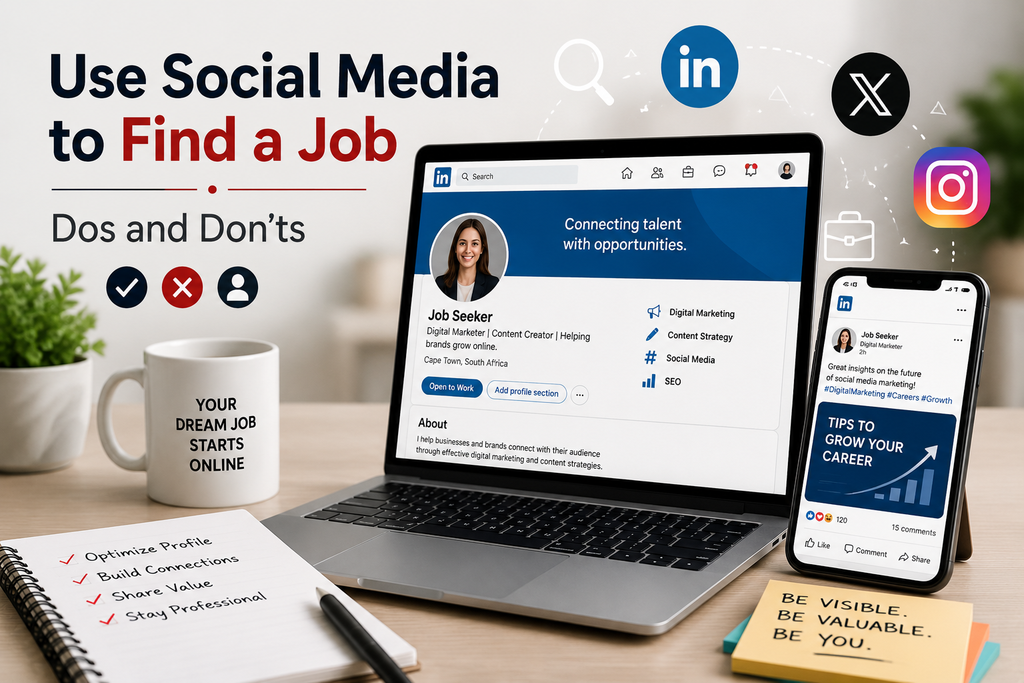
1. Make Your LinkedIn Profile Work for You
If you’re actively looking for professional employment, LinkedIn deserves particular attention.
Make sure your profile includes:
- A clear, professional photograph
- A specific headline that describes what you do
- A useful About section
- Your relevant experience and achievements
- Important skills and qualifications
- Links to your portfolio or professional work where appropriate
Don’t simply write:
“Looking for work.”
Instead, tell people what you do and what type of opportunity you’re interested in.
2. Use the Right Keywords
Recruiters may search LinkedIn and other professional platforms using terms related to particular skills, job titles and qualifications.
Use the terminology that employers in your industry actually use.
For example, if you’re a digital marketer, your profile might naturally include terms such as:
Digital Marketing | SEO | Social Media Marketing | Google Ads | Content Marketing
Don’t stuff your profile with keywords. Make sure they accurately describe your skills and experience.
Want Help Improving Your LinkedIn Profile?
Not sure whether your LinkedIn profile is doing enough to attract recruiters?
Careerflow’s LinkedIn Optimizer can analyze your profile and provide personalized suggestions for improving sections such as your headline, About section, skills and experience. It also provides a profile score and a step-by-step checklist to help you identify areas that need attention.
Try the free LinkedIn Profile Optimizer →
3. Share Useful Industry Content
You don’t need to publish an article every day.
Sharing a useful resource, commenting thoughtfully on an industry post or discussing something you’ve learned can help demonstrate that you’re interested in your field.
Your activity can be particularly useful when you’re trying to build professional connections.
4. Showcase Your Work
For some careers, showing what you can do is more powerful than simply saying what you can do.
Depending on your profession, you could showcase:
- Design projects
- Writing samples
- Photography
- Websites
- Coding projects
- Marketing campaigns
- Presentations
- Video work
- Professional certifications
Use a portfolio or appropriate platform where possible, and link to it from your professional profiles.
5. Follow Companies You Want to Work For
Following your target employers can help you stay informed about:
- New vacancies
- Company news
- Hiring campaigns
- Industry developments
- Networking opportunities
It also gives you something useful to talk about when you eventually contact someone at the company.
6. Build Genuine Professional Connections
You don’t need thousands of followers.
A smaller network of relevant people can be far more useful than collecting connections simply to increase a number.
Connect with people in your industry, former colleagues, recruiters, professionals whose work interests you and people working at companies you’d like to join.
Focus on building relationships rather than immediately asking everyone for a job.
The Don’ts: Social Media Mistakes That Could Hurt Your Job Search
1. Don’t Turn Every Interaction Into a Job Request
Sending the same message to dozens of recruiters saying “Hi, I’m looking for a job. Please help” isn’t a strong networking strategy.
If you’re contacting someone professionally, explain why you’re reaching out and keep the message relevant.
2. Don’t Lie About Your Experience
Your social media profiles, CV and portfolio should tell a consistent story.
Don’t exaggerate your qualifications, invent experience or claim responsibility for work you didn’t actually do.
Inconsistencies can damage your credibility when someone checks your background.
3. Don’t Complain About Employers or Colleagues
Everyone has bad workdays.
Publicly posting angry complaints about your current or previous employer, colleagues or clients can create an impression that you may not handle workplace disagreements professionally.
If you have a genuine employment dispute, social media is rarely the best place to resolve it.
4. Don’t Assume Privacy Settings Make Everything Private
Review the privacy settings on your personal accounts, but don’t rely on them completely.
Content can be screenshotted, shared or viewed by people outside your immediate network.
Before posting, consider whether you’d be comfortable with the content becoming publicly available.
5. Don’t Delete Everything Personal
Your social media accounts don’t need to look like a corporate brochure.
Employers aren’t necessarily looking for someone with a completely sterile online personality.
The goal is professional judgment, not pretending you have no life outside work.
6. Don’t Argue With Everyone Online
You don’t have to agree with everyone.
But aggressive arguments, abusive comments, discriminatory content or repeated hostile behaviour can create a very different impression from the professional person presented in your CV.
Think before you post, particularly when using a public account connected to your professional identity.
7. Don’t Forget to Check What People Can Find About You
Search your own name occasionally.
Look at your public social media profiles and search results from the perspective of someone who doesn’t know you.
Ask:
If an employer found this today, would it support or undermine my professional reputation?
If something clearly creates a problem, consider removing it, making it private or updating the information.
Should You Contact Recruiters on LinkedIn?
Yes, but do it thoughtfully.
If you find a recruiter who works in your industry, you can send a short, personalised connection request.
For example:
Hi Sarah, I noticed you recruit for marketing roles in Cape Town. I’m a digital marketer with experience in SEO and content marketing, and I’m currently exploring new opportunities. I’d be happy to connect.
That’s much better than sending:
“Hi, do you have any jobs?”
You don’t need to immediately ask for a vacancy. Start a professional conversation.
What About Facebook, Instagram and X?
You don’t have to maintain a professional presence on every platform.
Instead, consider where employers in your particular industry are likely to look.
A graphic designer might benefit enormously from Instagram and Behance.
A software developer may want to focus on LinkedIn and GitHub.
A marketer could use LinkedIn, Instagram and X to demonstrate their knowledge.
Someone looking for local employment may find Facebook groups useful.
Choose your platforms strategically rather than trying to be everywhere.
Your Social Media Should Support Your Job Search
You don’t need to become a social media influencer to use social media effectively.
The most useful strategy is surprisingly simple:
Be findable. Be credible. Be professional. Be yourself.
Keep your professional information up to date, showcase relevant work, connect with people in your industry and think carefully before posting publicly.
Your social media presence won’t replace a strong CV or good interview skills, but it can help you get noticed, build professional connections and discover opportunities you might otherwise miss.
Looking for More Job Search Help?
KLB Recruitment provides practical resources to help job seekers navigate the entire job-search process, from writing a stronger CV and preparing for interviews to finding legitimate job sites, learning new skills and using modern job-search tools.
Frequently Asked Questions: How to Use Social Media to Find a Job
Do employers really check social media before hiring?
Some employers and recruiters may review publicly available information about candidates, although practices vary between companies and industries. It’s sensible to make sure your public online presence is professional and consistent with your application.
Which social media platform is best for finding a job?
LinkedIn is generally the most useful platform for professional networking and job searching, but the best platform depends on your industry. Creative professionals may benefit from Instagram or Behance, while developers may find GitHub particularly valuable.
Should I put “Looking for a job” on LinkedIn?
You can, but be more specific if possible. Explain what type of work you do and the kind of opportunities you’re looking for. LinkedIn also provides features designed to indicate that you’re open to opportunities.
Should I connect with recruiters on LinkedIn?
Yes. Connecting with relevant recruiters can be a useful part of your job search. Personalise your connection requests where appropriate and focus on building professional relationships rather than repeatedly asking for jobs.
Should I delete my personal social media accounts when looking for a job?
No. You don’t need to delete your personal accounts. Instead, review what is publicly visible, check your privacy settings and remove or hide content that you wouldn’t want associated with your professional reputation.
Can social media help me get a job without applying?
Sometimes. Employers and recruiters may discover candidates through professional networking, posts, portfolios or recommendations. However, social media should complement your job search rather than replace applying for suitable positions.
What should I post on LinkedIn when I’m looking for work?
Share useful industry information, professional achievements, projects you’ve worked on, relevant insights, certifications or lessons you’ve learned. You can also share that you’re open to suitable opportunities, particularly when you can clearly describe the type of role you’re seeking.
Related Posts
Learn How to Spot a Fake Job Offer and Job Scams – keep yourself safe.
Affiliate Disclosure
Some of our articles may include links to products, services, or resources that we believe could be helpful to job seekers and employers, some of which are affiliate links, which means we may earn a small commission if you make a purchase, at no extra cost to you. These small commissions help support our editorial team, so we can continue reviewing, testing, and sharing the most useful and effective tools and resources for job seekers.