Last Updated on 03/09/2026 by KLB Editorial Team
Changing careers doesn’t always mean starting completely from scratch. In many cases, you can build on the experience you already have by developing new skills that are relevant to the type of work you want to move into.
Whether you’re looking for a better job, considering a career change, trying to qualify for remote work or want to add valuable skills to your CV, online courses can be a practical way to upskill without committing to a full-time qualification.
The challenge is knowing which skills are actually worth learning.
Table of Contents
How Do You Know Which Skills to Learn?
Don’t start by randomly choosing an online course because it looks interesting.
Start with the job you want.
Look at current job advertisements for the type of position you’re targeting and make a note of the skills employers repeatedly request.
For example, if you’re interested in digital marketing, you might find employers asking for:
- SEO
- Social media marketing
- Content creation
- Google Ads
- Analytics
- Email marketing
If you’re interested in administration, you may see requirements such as:
- Microsoft Excel
- Microsoft 365
- Data entry and management
- Communication
- Customer service
- Organisation
This gives you a much better starting point than simply collecting random certificates.
Learn skills that can help you qualify for the jobs you actually want.
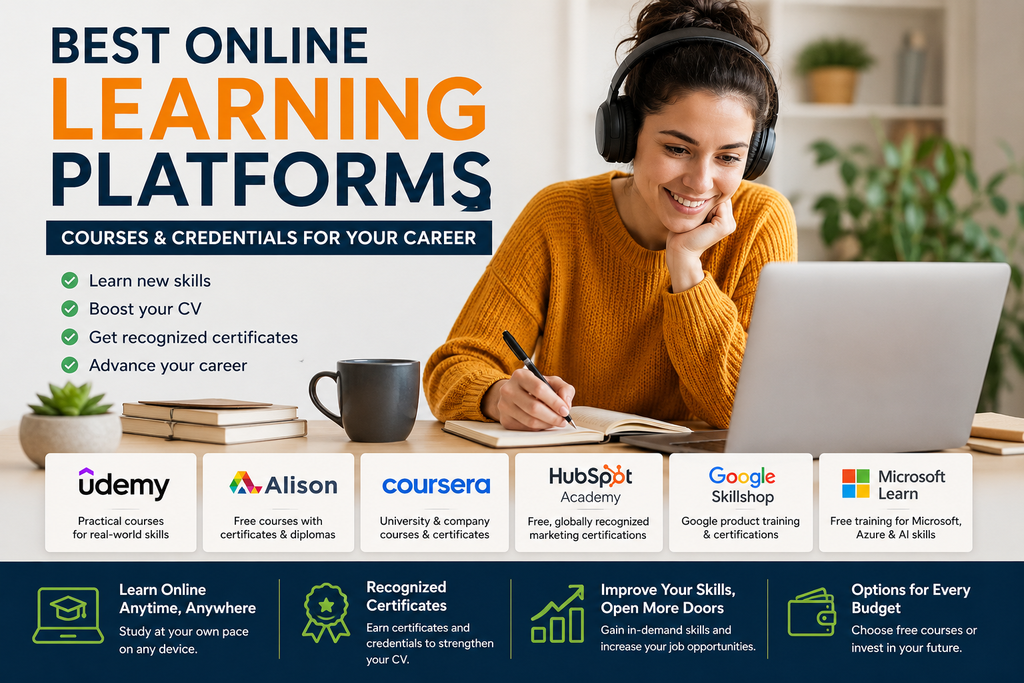
6 Best Online Course Platforms for Career Skills
1. Udemy
Best for: Practical career skills and learning a specific skill quickly.
Udemy offers a huge catalogue of courses covering AI, technology, business, digital marketing, data, design, project management, leadership, productivity and many other subjects.
You can buy individual courses or use Udemy’s Personal Plan, which currently provides access to a curated collection of more than 26,000 courses. Individual course purchases provide lifetime access to the course, while the Personal Plan provides access while your subscription is active.
Is Udemy free?
Some Udemy courses are free, but most of the platform’s extensive professional catalogue is paid.
You can also find courses at different price points, making it possible to learn a specific skill without committing to a long-term subscription.
Do Udemy courses provide certificates?
Yes. Completing an eligible Udemy course gives you a certificate of completion.
However, it’s important to understand that a Udemy certificate of completion is not automatically the same as a professional certification or formal qualification.
Some Udemy courses prepare you for external certifications from organisations such as AWS, Microsoft, Google, CompTIA or PMI, but the external certification is separate from simply completing the Udemy course.
What can you learn?
Popular career-related areas include:
- Artificial intelligence
- IT and cloud computing
- Coding and web development
- Data analysis
- Digital marketing
- Project management
- Microsoft Office
- Business and leadership
- Graphic design
- Cybersecurity
Why choose Udemy?
Udemy is particularly useful when you know exactly what skill you want to learn and want a large choice of courses from different instructors.
2. Coursera
Best for: Professional certificates and structured learning from universities and companies.
Coursera offers courses, professional certificates and degrees from universities and companies around the world.
Its catalogue covers areas including technology, data, AI, business, marketing, project management and many other professional fields.
Is Coursera free?
Coursera has some free learning options, but professional certificates and many complete courses require payment or a subscription.
Some programmes may also offer financial aid or other access options.
Do Coursera courses provide recognised certificates?
This is one of Coursera’s strengths.
Its Professional Certificates are offered by recognised companies and institutions and can be used to demonstrate completion of structured professional training.
However, a professional certificate is not necessarily equivalent to a formal university degree or professional licence. Check exactly what credential a particular programme provides before enrolling.
What can you learn?
- Artificial intelligence
- Data science
- Business
- Project management
- Digital marketing
- Cybersecurity
- IT
- Leadership
- Finance
- Software development
Why choose Coursera?
Coursera is a strong option if you want structured learning and a credential from a recognised university or company, rather than simply taking a short course on a particular topic.
3. Alison
Best for: Affordable and accessible career learning, including CPD-accredited courses.
Alison offers thousands of online courses covering business, IT, management, health, languages, personal development, sales and marketing, and many other subjects.
One of Alison’s biggest advantages is that the courses themselves are free to study.
Is Alison free?
Yes. Alison courses are free to study and complete.
Certificates and diplomas are generally optional purchases after completing a course, although Alison does have a selection of courses offering free digital certificates.
Are Alison certificates recognised?
This requires a little explanation.
Alison states that its courses are now being accredited by CPD UK, meaning certificates from relevant CPD-accredited courses can be used as part of CPD requirements, subject to the requirements of the organisation you’re dealing with.
That does not make an Alison certificate equivalent to a university degree, nationally recognised qualification or South African SAQA/NQF qualification.
For a CV, think of an Alison certificate primarily as evidence that you’ve completed relevant training and developed a particular skill.
What can you learn?
Popular areas include:
- Business and management
- IT and computer skills
- Microsoft Office
- Project management
- Sales and marketing
- Human resources
- Languages
- Personal development
- Health and safety
Why choose Alison?
Alison is particularly attractive if you want to explore a new career area or develop useful skills without paying for the learning itself.
👉 Explore Alison’s Free Courses →
4. HubSpot Academy
Best for: Marketing, sales, CRM and customer-service skills.
HubSpot Academy is particularly useful if you’re interested in digital marketing, sales, customer service, content marketing or CRM.
The platform offers free online training as well as certifications.
Is HubSpot Academy free?
Yes. HubSpot Academy training and its certifications are free.
Some HubSpot software certifications may have additional requirements depending on the certification, but the Academy itself provides a large amount of free professional training.
Are HubSpot certifications recognised?
Yes. HubSpot describes its certifications as globally recognised, and you can add them to your CV and LinkedIn profile.
These are industry certifications rather than university qualifications.
What can you learn?
- Digital marketing
- Content marketing
- Social media
- Email marketing
- Sales
- Customer service
- CRM
- Inbound marketing
- Reporting and analytics
Why choose HubSpot Academy?
If you’re targeting marketing, sales or customer-facing roles, HubSpot certifications can give you specific industry knowledge and a recognised credential without paying for the training.
5. Google Skillshop
Best for: Google products, digital advertising and analytics.
Google Skillshop provides online training created around Google products and tools.
It is particularly useful for people interested in digital marketing, advertising, analytics and other Google-related skills.
Is Google Skillshop free?
Yes. Google provides its Skillshop training online, allowing you to learn at your own pace.
Does Google Skillshop offer recognised certifications?
Yes, for specific Google products and programmes.
For example, Google Skillshop offers Google Ads certifications, along with training around Google Analytics, Google Marketing Platform and other Google products.
These are Google product certifications, rather than general academic qualifications.
What can you learn?
- Google Ads
- Google Analytics
- Google Marketing Platform
- Google Ad Manager
- Google AdMob
- Other Google advertising and business products
Why choose Google Skillshop?
If you’re targeting digital marketing or advertising roles where Google tools are relevant, a Google certification can be much more directly useful than a generic online course.
6. Microsoft Learn
Best for: Microsoft, Azure, AI, cloud and technical skills.
Microsoft Learn provides free, self-paced training covering Microsoft’s technologies and professional tools.
It is particularly useful for people developing skills in areas such as Azure, AI, Microsoft 365, data, security and software development.
Is Microsoft Learn free?
Yes. Microsoft Learn training is free.
However, don’t confuse completing Microsoft Learn training with earning a Microsoft Certification.
Does Microsoft Learn offer recognised credentials?
Microsoft offers formal Microsoft Certifications and Microsoft Applied Skills credentials.
Certifications are earned through role-based exams, while Applied Skills credentials are earned through interactive, lab-based assessments designed to demonstrate specific real-world skills.
These are Microsoft-verified credentials and can be shared with employers.
What can you learn?
- Microsoft Azure
- Artificial intelligence
- Microsoft 365
- Cybersecurity
- Data
- Cloud computing
- Software development
- Power Platform
- Microsoft Copilot
Why choose Microsoft Learn?
If you’re interested in technology, cloud computing, AI or Microsoft-based business roles, Microsoft Learn gives you free training that can also prepare you for formal Microsoft credentials.
Which Skills Are Worth Learning in 2026?
There isn’t one list of skills that guarantees employment.
The best skills depend on your industry, experience and career goals.
However, several categories can be useful across a wide range of careers.
Artificial Intelligence & Digital Skills
AI is becoming part of many different workplaces, not just technology companies.
Learning how to use AI tools effectively can complement existing skills in areas such as administration, marketing, customer service, research, content creation and business.
Data & Excel Skills
Data skills are valuable in many office and business roles.
Even improving your Excel skills can make you more competitive for administrative, finance, operations and data-related positions.
Digital Marketing
SEO, social media, content marketing, email marketing, paid advertising and analytics can be useful for both employment and freelance work.
Project Management
Project management skills can be useful across industries because organisations need people who can organise tasks, manage deadlines, communicate with teams and keep projects moving.
Communication & Customer Service
Technical skills aren’t everything.
Communication, problem-solving and customer service skills remain important in many roles, particularly where you work with customers, clients or colleagues.
Freelance & Remote Work Skills
If you’re interested in freelancing or remote work, skills such as writing, graphic design, web development, digital marketing, bookkeeping, video editing and virtual assistance can potentially be turned into freelance services.
👉 Get more tips in our guide on the Top 5 Skills Employers Look for in 2026.
Should You Take a Course for a Career You Have No Experience In?
You can. An online course won’t automatically qualify you for a job, but it can help you build foundational knowledge and demonstrate initiative when changing careers.
The important thing is to go beyond simply completing the course.
For example, if you take a digital marketing course, create a small marketing project.
If you learn graphic design, create portfolio examples.
If you learn data analysis, work on a practical dataset.
If you learn web development, build something you can show an employer.
A certificate tells an employer you completed training. A practical example can show them what you can actually do.
Are Online Course Certificates Worth It?
They can be, but don’t assume that every certificate will make your CV more valuable.
A certificate is most useful when:
- The skill is relevant to the job
- Employers specifically request it
- The course comes from a reputable provider
- You can demonstrate the knowledge you’ve gained
- It supports your existing experience
Don’t fill your CV with dozens of unrelated certificates.
Five relevant courses won’t necessarily impress an employer more than one genuinely useful skill that you can demonstrate.
Free vs Paid Online Courses
You don’t necessarily need to spend a fortune on upskilling.
Platforms such as Alison, Google Skillshop and Microsoft Learn provide free learning opportunities, while many other platforms offer individual courses at relatively affordable prices.
However, paid courses can make sense when you want:
- More structured instruction
- Practical projects and exercises
- Specialist training
- Certification preparation
- More comprehensive coverage of a subject
- A course created specifically around a professional skill
The question isn’t simply “Is this course free?”
It’s:
“Will this course help me develop a skill that is useful for the career I’m pursuing?”
If the answer is yes, a reasonably priced course can be a worthwhile investment.
How to Choose the Right Online Course
Before paying for a course, take a few minutes to check:
1. Look at the job market
Search current job advertisements and identify the skills employers are requesting.
2. Check the course content
Make sure the course actually teaches the skills you need.
3. Look at the instructor
Check their experience, qualifications and reviews where available.
4. Consider practical learning
Courses that include exercises, projects or real-world examples can give you something useful to demonstrate later.
5. Don’t buy courses just to collect certificates
Your objective is to become more employable, not to build the world’s largest collection of digital certificates.
How to Add New Skills to Your CV
Once you’ve developed a relevant skill, add it to the appropriate section of your CV.
You can include:
- The skill itself
- Relevant certifications
- Courses and training
- Practical projects
- Results you’ve achieved using the skill
For example:
Digital Marketing Certification – HubSpot Academy
or:
Google Ads Certification – Google Skillshop
or, where appropriate:
Microsoft Certified: Azure Fundamentals
Then explain how you have applied the skill if you have practical experience.
Need help improving your CV? Explore our CV Tips & Tools →
Can Upskilling Help You Find a Job Faster?
Upskilling isn’t a magic shortcut to employment.
However, developing relevant skills can give you access to more opportunities, strengthen your CV and make it easier to move into roles where your existing experience alone may not have been enough.
It can also help you discover career options you hadn’t previously considered.
The key is to be strategic.
Don’t learn everything. Learn what moves you closer to the work you want.
Frequently Asked Questions
Are there really free online courses?
Yes. Several established learning platforms provide free courses, training resources, or free access to course content. Some platforms charge for certificates, assessments, or additional features, so check the terms before enrolling.
Can online courses help me get a job?
They can help you develop relevant knowledge and skills, but completing a course does not guarantee employment.
The most useful courses are those that teach skills relevant to the jobs you’re applying for and that you can demonstrate through practical work or examples.
What skills are most useful for getting a job?
There isn’t one universal list because skills vary by industry and role. However, digital skills, communication, Microsoft Office skills, data skills, customer service, project management, and industry-specific technical skills are commonly useful across different types of employment.
The best approach is to look at current job advertisements in your target field and identify recurring skill requirements.
Should I pay for an online course?
Not necessarily. Start by looking for reputable free learning resources. If you need more structured training, practical projects, specialist instruction, or a recognised qualification, paying for a course may make sense.
Always compare the course content, cost, reputation, and relevance to your career goals before paying.
Are online course certificates worth putting on my CV?
They can be, particularly when the course is relevant to the position and comes from a reputable provider.
However, avoid filling your CV with unrelated certificates. Focus on training that demonstrates useful skills for the jobs you’re targeting.
How can I choose a course that employers will value?
Look at current job advertisements for your target role and identify the skills employers repeatedly request.
Then choose training that helps you develop those skills. Industry-recognised qualifications and certifications can be particularly valuable where employers specifically mention them as requirements or preferences.
Can I learn skills for freelancing online?
Yes. Online courses can help you develop skills that can potentially be offered as freelance services, including writing, graphic design, web development, digital marketing, video editing, bookkeeping, and virtual assistance.
Once you have developed a skill, you can explore freelance marketplaces and other side-hustle opportunities.
How much time should I spend upskilling while looking for a job?
There is no fixed amount. Even a few hours a week can make a difference if you focus on skills that are relevant to your career goals. Try to balance learning with applying for suitable jobs, networking, and preparing for interviews. The goal is to become more employable, not to spend all your time collecting courses.
How many courses should I take?
There is no magic number. Focus on learning the skills you actually need rather than completing as many courses as possible. One relevant course combined with practical experience can be more valuable than ten unrelated certificates.
Keep Building Your Career
Your career doesn’t have to stay on the same path forever.
Whether you’re improving your existing skills, preparing for a promotion, changing careers or looking for new opportunities, online learning gives you a flexible way to keep developing.
Start with the jobs you want.
Find the skills employers are asking for.
Then learn those skills and put them into practice.
More Helpful Resources
Looking for work right now?
- Explore our job search resources, CV tips and tools and interview preparation resources to strengthen the rest of your job search.
- Read our guide on the Top Skills Employers Are Looking for in 2026 for more valuable tips.
Affiliate Disclosure
Some of our articles may include links to products, services, or resources that we believe could be helpful to job seekers and employers, some of which are affiliate links, which means we may earn a small commission if you make a purchase, at no extra cost to you. These small commissions help support our editorial team, so we can continue reviewing, testing, and sharing the most useful and effective tools and resources for job seekers.