Last Updated on 03/09/2026 by KLB Editorial Team
The skills employers look for are changing as technology, workplace expectations, and the way people work continue to evolve. But knowing which skills are in demand is only half the battle.
The real challenge is showing employers that you actually have those skills.
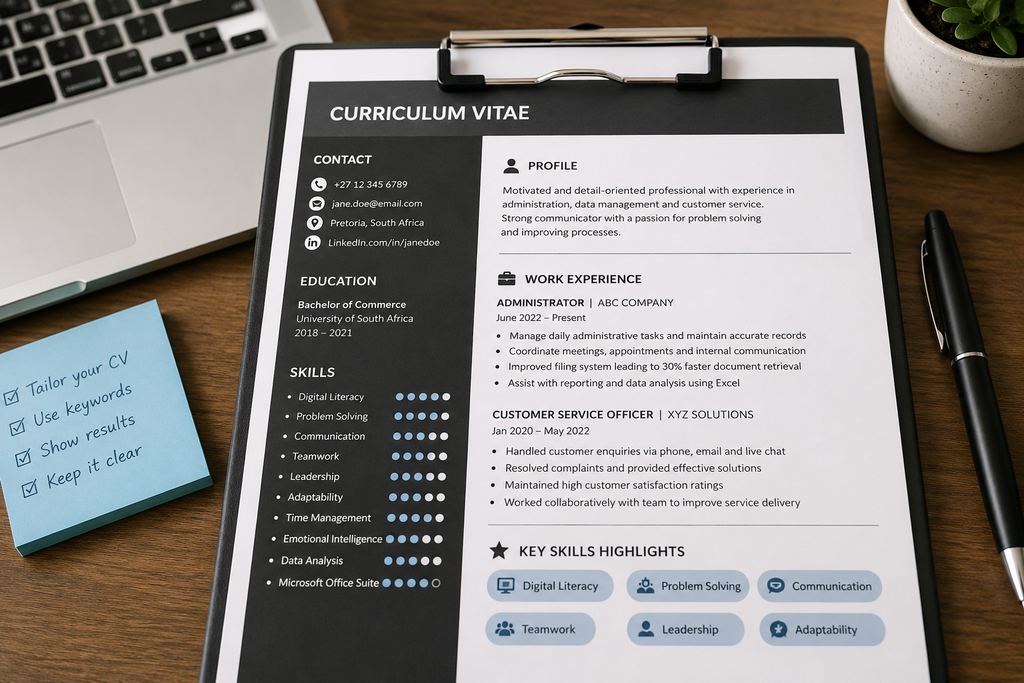
Simply writing “excellent communication skills” or “strong problem-solving abilities” in a skills section doesn’t provide much evidence. A stronger CV demonstrates how you have used those skills and, where possible, what you achieved as a result.
Whether you’re actively job hunting or updating your CV for future opportunities, understanding the skills employers are looking for in 2026 can help you create a more relevant and convincing application.
If you’re starting your CV from scratch, our guide on How to Create a Professional CV walks you through the essential sections and what to include.
Table of Contents
What Skills Are Employers Looking for in 2026?
There isn’t one universal list of skills that every employer wants. The most important skills depend on the industry, role, seniority, and organisation.
However, several broad skills continue to appear across a wide range of jobs, particularly as workplaces become increasingly digital and collaborative.
Here are five skills worth considering when updating your CV.
1. Digital Literacy & Technology Adaptability
Digital skills are no longer limited to technology jobs. Employers across administration, finance, retail, marketing, customer service, education, healthcare, and many other industries expect employees to be comfortable using technology.
Being digitally literate doesn’t mean you need to be an expert in artificial intelligence or programming. It can mean being comfortable learning new software, using workplace technology, working with digital communication tools, or adapting when an employer introduces a new system.
How to showcase digital skills on your CV
Avoid simply writing:
Digital literacy
Instead, mention the specific tools and technologies you can use.
For example:
- Microsoft Excel, Word and PowerPoint
- Microsoft Teams and Outlook
- CRM systems
- Google Workspace
- Project management software
- Point-of-sale systems
- Industry-specific software
- Data and reporting tools
Then show how you used those tools.
Weak:
“Proficient in Microsoft Excel.”
Stronger:
“Used Excel to maintain monthly sales reports, analyse customer data and identify discrepancies in order records.”
The second example gives the employer evidence of what you can actually do.
Don’t exaggerate your technology skills
If you’ve only used a programme occasionally, don’t describe yourself as an advanced user.
Being honest about your level is important because employers may test your skills during the recruitment process.
If there is a technology or software package that repeatedly appears in the jobs you’re applying for, consider using the Upskill & Learn resources to develop your knowledge.
2. Critical Thinking & Problem Solving
Employers don’t want employees who simply identify problems. They want people who can understand what is happening, consider possible solutions, and take appropriate action.
Problem-solving can appear in almost any job.
A customer service employee might resolve a difficult customer complaint. An administrator might identify a process causing delays. A warehouse employee might find a way to reduce picking errors. A manager might solve a staffing or operational problem.
How to showcase problem-solving on your CV
Use your work experience to demonstrate:
The problem → what you did → the result
For example:
Weak:
“Good problem-solving skills.”
Stronger:
“Identified recurring invoice-processing errors and introduced a revised checking process that reduced monthly corrections by 25%.”
If you don’t have a measurable percentage, that’s fine. You can still describe the outcome.
For example:
“Resolved recurring customer account issues by identifying errors in the existing process and coordinating corrections with the finance team.”
The important thing is to show what you actually did.
Useful action verbs
When describing problem-solving achievements, consider verbs such as:
- Analysed
- Investigated
- Identified
- Resolved
- Improved
- Streamlined
- Reduced
- Corrected
- Redesigned
- Implemented
3. Communication & Collaboration
Strong communication remains one of the most transferable workplace skills.
This includes written communication, verbal communication, listening, presenting information clearly, collaborating with colleagues, and communicating with customers or clients.
Remote and hybrid working have also increased the importance of communicating effectively through digital tools.
How to showcase communication skills on your CV
Don’t simply write:
“Excellent communication skills.”
Instead, demonstrate where and how you used them.
For example:
“Communicated with customers by phone and email, resolving an average of 40 enquiries per day while maintaining a high customer satisfaction rating.”
Or:
“Coordinated communication between sales, warehouse and finance teams to ensure customer orders were processed accurately and on time.”
You can also mention relevant tools if they are genuinely part of your experience:
- Microsoft Teams
- Zoom
- Slack
- Microsoft Outlook
- Google Workspace
- Customer relationship management systems
However, knowing how to use Teams is not itself a communication achievement. The important part is explaining what you used the tool to accomplish.
4. Initiative, Adaptability & Leadership
Leadership isn’t limited to people with “Manager” or “Team Leader” in their job title.
Employers also value employees who take responsibility, identify opportunities to improve things, learn new processes, and contribute without constantly waiting to be told what to do.
Adaptability is particularly important in workplaces where technology, processes, responsibilities, and customer expectations can change quickly.
How to showcase initiative on your CV
Think about situations where you:
- Volunteered to take responsibility for something
- Suggested a process improvement
- Helped train a colleague
- Took responsibility for solving a problem
- Learned a new system
- Took on additional responsibilities
- Helped your team during a busy period
- Introduced a more efficient way of doing something
For example:
Weak:
“Strong leadership skills and a good team player.”
Stronger:
“Took responsibility for training three new team members on company procedures, helping them become independently productive within their first month.”
You don’t need to claim that you “led a team” if you didn’t. Leadership can be demonstrated through responsibility, initiative and influence.
5. Emotional Intelligence & People Skills
Technical abilities can help you qualify for a position, but employers also need people who can work effectively with colleagues, customers, managers, and other stakeholders.
Emotional intelligence includes skills such as:
- Empathy
- Active listening
- Self-awareness
- Conflict management
- Adaptability
- Teamwork
- Understanding different perspectives
- Managing your response to difficult situations
These skills can be particularly important in customer-facing, management, healthcare, education, sales, and team-based roles.
How to showcase emotional intelligence on your CV
Don’t simply put “high emotional intelligence” in your skills section. It is much more convincing to demonstrate the behaviour.
For example:
“Managed difficult customer complaints calmly and professionally, identifying appropriate solutions while maintaining positive customer relationships.”
Or:
“Supported colleagues during a period of increased workload by helping redistribute tasks and coordinating priorities across the team.”
These examples demonstrate interpersonal skills without needing to label yourself as “emotionally intelligent.”
Don’t Just List Skills. Prove Them.
This is one of the most important things to remember when updating your CV.
A skills section can tell an employer what you claim to be good at.
Your work experience can show them what you’ve actually done.
Compare:
Skills: Communication, teamwork, leadership, problem solving, organisation.
with:
Experience:
Coordinated daily workloads across a five-person administration team, resolving scheduling issues and ensuring priority customer requests were handled within agreed deadlines.
The second example demonstrates several skills without simply listing them.
Whenever possible, use your employment history to provide evidence of the skills in your skills section.
How to Match Your Skills to the Job Description
The skills employers want aren’t identical for every position.
Before applying, read the job description carefully and identify:
- Technical skills
- Software and tools
- Qualifications
- Industry knowledge
- Communication requirements
- Teamwork requirements
- Leadership responsibilities
- Other repeated keywords
Then compare those requirements with your own experience.
For example, if a job advertisement repeatedly mentions Excel, customer service, reporting and attention to detail, those are more important to highlight than generic skills that aren’t relevant to the position.
This is also useful for Applicant Tracking Systems (ATS), which may scan CVs for relevant keywords before a recruiter reviews the application.
However, don’t simply copy every keyword from the job advertisement into your CV. Use keywords that genuinely describe your skills and experience.
What If You Don’t Have Much Work Experience?
You don’t need years of employment history to demonstrate valuable skills.
If you’re a graduate, school leaver, career changer, or returning to work, consider examples from:
- Internships
- Volunteering
- Freelance work
- University or college projects
- School activities
- Community projects
- Part-time work
- Personal projects
- Side hustles
- Student societies
- Informal responsibilities
For example, organising a community event could demonstrate planning, communication, teamwork and problem-solving.
A freelance project could demonstrate client communication, time management and technical skills.
The key is to identify what you did and what it demonstrates.
How to Improve the Skills You Don’t Have Yet
If a job repeatedly asks for a skill you don’t currently have, don’t automatically assume the opportunity is out of reach.
Look for reputable courses and learning resources that can help you develop the skill.
There are many free and affordable ways to learn online, including resources from Google, Microsoft, Alison, and other training providers.
Visit our Upskill & Learn page for free and affordable learning resources for job seekers.
Just remember that completing a course is only the beginning. Whenever possible, practice the skill and create something that demonstrates what you’ve learned.
Don’t Forget About Transferable Skills
Some of your most valuable skills may not come directly from your current job.
Transferable skills are abilities that can be used across different roles and industries.
Examples include:
- Communication
- Organisation
- Customer service
- Time management
- Problem-solving
- Teamwork
- Leadership
- Research
- Attention to detail
- Adaptability
- Digital literacy
For someone changing careers, these skills can help connect previous experience to a new type of role.
For example, a retail employee may have developed strong customer service, communication, cash-handling, stock management and problem-solving skills that could transfer into administration, sales or customer support.
Tailor Your CV for Every Application
You don’t necessarily need to rewrite your entire CV every time you apply for a job.
However, you should make sure the skills and experience most relevant to the particular position are easy to find.
Before submitting your application:
- Read the job description carefully.
- Identify the most important skills and requirements.
- Highlight relevant experience near the top of your CV.
- Use accurate keywords from the job description where they genuinely apply.
- Replace generic statements with specific examples.
- Quantify achievements where possible.
- Remove irrelevant information that takes attention away from your strongest qualifications.
The Bottom Line
The most valuable skills on your CV aren’t necessarily the ones that sound impressive. They’re the ones you can demonstrate with credible evidence.
Digital adaptability, problem-solving, communication, initiative, leadership, and emotional intelligence can all strengthen your CV, but simply listing them isn’t enough.
Show employers where you’ve used these skills, explain what you did, and include the results whenever possible.
And remember: the best skills to highlight are ultimately the ones that match the job you’re applying for and that you can genuinely demonstrate.
Frequently Asked Questions: Top 5 Skills Employers Look for
What are the most important skills to put on a CV in 2026?
The most important skills depend on the job you’re applying for. However, digital literacy, problem-solving, communication, adaptability, teamwork, initiative, and other transferable skills are useful across many industries.
The key is to prioritise skills that are relevant to the specific position and support them with examples from your experience.
Should I list soft skills on my CV?
Yes, but don’t rely on a list of soft skills by itself.
Rather than simply writing “excellent communication” or “strong leadership skills”, demonstrate those abilities through your employment history and achievements.
For example, explaining how you resolved customer complaints or coordinated a project provides much stronger evidence than simply stating that you have good communication skills.
How many skills should I put on my CV?
There is no fixed number, but your CV should focus on the skills that are most relevant to the position.
A focused list of around 8–12 relevant skills can be more effective than listing every skill you have ever used. Prioritise the requirements that appear repeatedly in the job description and that you can genuinely demonstrate.
How do I show skills on my CV if I don’t have much work experience?
You can demonstrate skills through more than paid employment.
Consider examples from internships, volunteering, education, freelance projects, part-time work, community activities, student organisations, personal projects, or side hustles.
For example, organising a university project could demonstrate teamwork, planning, communication, and problem-solving.
Should I include skills I am currently learning?
You can include a skill that you’re actively developing, but make your level clear.
For example, you could write “Basic Excel” or “Currently completing an introductory digital marketing course” rather than presenting yourself as an experienced professional.
Never claim a level of expertise that you cannot demonstrate if an employer asks you about it or tests your ability.
Should I use keywords from the job description on my CV?
Yes, when the keywords accurately describe your own skills and experience.
Many employers use Applicant Tracking Systems (ATS) to help screen applications, so using relevant terminology can help your CV match the requirements of the position.
However, don’t simply copy the job description. Your CV should use keywords naturally while providing genuine evidence of your abilities.
What is the difference between technical skills and transferable skills?
Technical skills are specific abilities or knowledge required to perform particular tasks, such as Excel, accounting software, coding, data analysis, or graphic design.
Transferable skills can be used across different jobs and industries. Examples include communication, organisation, teamwork, problem-solving, customer service, and time management.
A strong CV can include both, depending on the requirements of the role.
Should I put skills at the top of my CV?
Your most relevant skills should be easy for the employer to find, but there is no single correct CV layout for everyone.
Your professional experience, qualifications, profile, and skills should be arranged so that the information most relevant to the job is immediately visible.
Can I learn new skills to improve my chances of getting hired?
Yes. Developing relevant skills can help you become more competitive, particularly if job advertisements in your target field repeatedly request skills you don’t currently have.
Look for reputable free or affordable courses and focus on skills that are genuinely relevant to the jobs you want.
Should I use an online CV builder?
An online CV builder can be useful if you’re unsure how to structure your CV, want access to professional templates, or need help creating and formatting your document.
However, don’t choose a template simply because it looks impressive. Your CV should remain easy to read, professional, and suitable for the type of position you’re applying for.
Related Posts
- For more help creating a strong, targeted CV, see our How to Create a Professional CV guide.
- Once your CV is ready, your next step is making sure your application is complete. See our guide to Writing a Professional Cover Letter for advice on creating a strong cover letter that supports your CV.
- If you’d rather use a tool to help with the structure and formatting of your CV, see our guide to Top Online CV Builders.
- For some careers, a portfolio is an important part of your job application. View our guide on How to Create a Professional Online Portfolio.
Affiliate Disclosure
Some of our articles may include links to products, services, or resources that we believe could be helpful to job seekers and employers, some of which are affiliate links, which means we may earn a small commission if you make a purchase, at no extra cost to you. These small commissions help support our editorial team, so we can continue reviewing, testing, and sharing the most useful and effective tools and resources for job seekers.