
Last Updated on 03/09/2026 by KLB Editorial Team
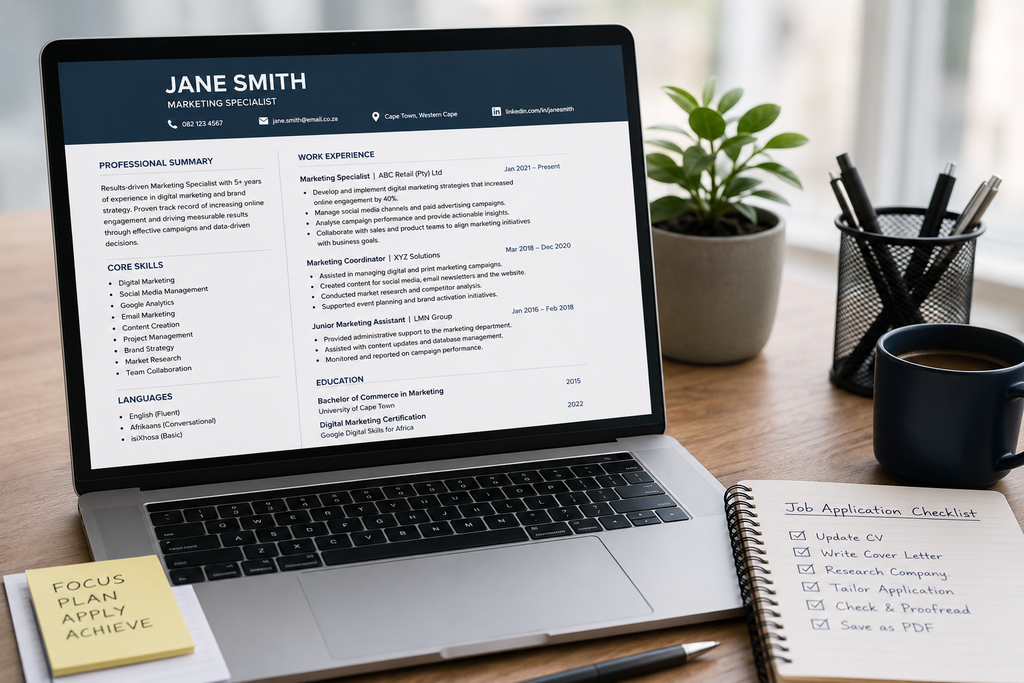
Knowing how to build a professional CV and cover letter can feel overwhelming, especially when you’re applying for jobs alongside hundreds of other candidates.
Your CV is often the first opportunity you have to show an employer what you can offer. A strong CV doesn’t need to be complicated or filled with fancy graphics. It needs to be clear, relevant, easy to read and focused on the value you can bring to the role.
As a recruiter with more than 20 years of experience in the South African market, I’ve seen what makes applications stand out and what can cause them to be overlooked.
This guide will walk you through how to create a professional CV from scratch, what information to include, and how to make your CV more ATS-friendly.
Table of Contents
How to Create a Strong CV
A strong CV should give an employer a clear picture of who you are, what you can do and what you have achieved.
A well-structured CV should be:
- Easy to read
- Relevant to the position
- Well structured
- Free from spelling and grammatical errors
- Focused on your skills and achievements
- Appropriate for Applicant Tracking Systems (ATS) where these are used
You don’t need to use an elaborate design. In many cases, a simple and professional layout is more effective.
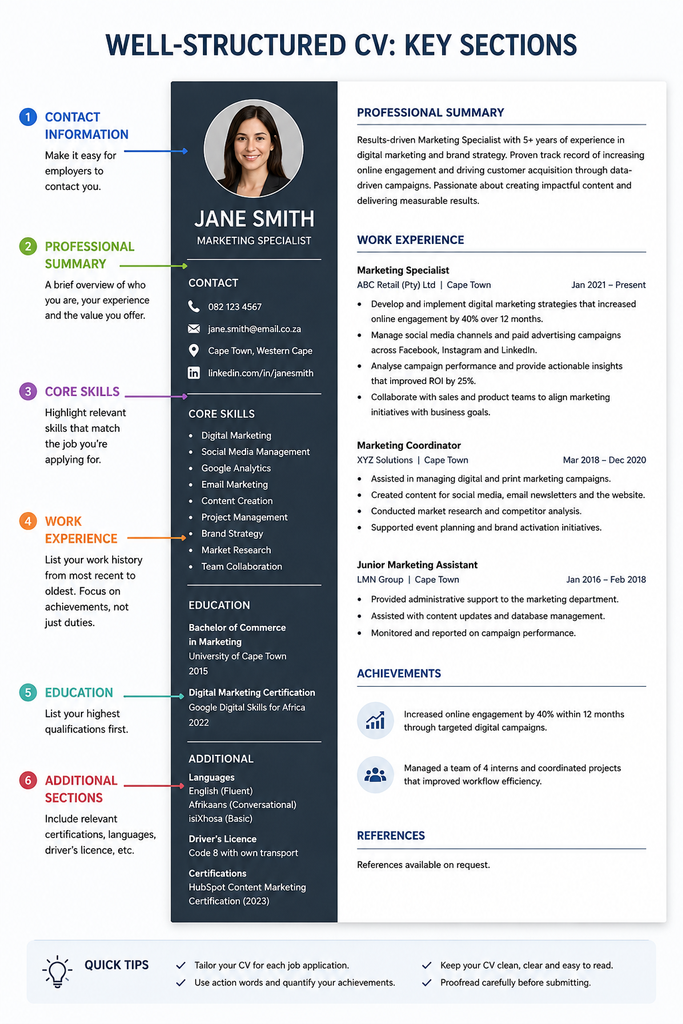
1. Contact Information
Start your CV with your basic contact details.
Include:
- Your full name
- Mobile phone number
- Professional email address
- City and province
- LinkedIn profile, if you have one
Use a professional email address such as firstname.lastname@email.com, rather than an informal address you created years ago.
You generally don’t need to include your full street address. Your city and province are usually sufficient.
South African tip: If the position requires a specific driver’s licence, vehicle or other practical requirement, make this easy to find. For example, if a job requires a Code 8/Code 10 licence or PDP, list the relevant licence clearly rather than making the recruiter search for it.
2. Write a Strong Professional Summary
Your professional summary is a short introduction at the top of your CV.
Think of it as your opportunity to answer three questions:
Who are you? What experience do you have? What can you bring to this employer?
Aim for around 3–4 sentences rather than a long paragraph.
Weak example:
“Hardworking individual looking for a challenging position where I can use my skills and grow within the company.”
This tells an employer very little.
Stronger example:
“Results-driven Marketing Specialist with 5+ years of experience in digital marketing and brand strategy. Proven track record of increasing online engagement and developing successful customer acquisition campaigns. Experienced in managing multiple projects, analysing campaign performance and working across digital channels.”
The second example immediately tells the employer what the candidate does, how much experience they have and where their strengths lie.
Tip: Your professional summary should change when necessary to reflect the type of position you’re applying for.
3. Highlight Your Core Skills
Create a clear skills section beneath your professional summary.
Include skills that are relevant to the position you’re applying for.
For example:
- Project Management
- Customer Relationship Management
- Microsoft Excel
- Digital Marketing
- Sales
- Financial Reporting
- Team Leadership
- Administration
- Data Analysis
Don’t simply fill this section with generic phrases such as “hard worker” or “team player.”
Look at the job advertisement and identify the skills and requirements the employer is actually looking for.
Use the language of the job advertisement
If the vacancy repeatedly refers to stock control, for example, and you have experience in stock control, use that terminology in your CV.
This can help both recruiters and ATS software identify the relevance of your experience.
South African tip: If you speak additional languages that are relevant to the role, include them. Languages such as isiZulu, Afrikaans, Sesotho or isiXhosa can be valuable for positions involving customers, clients, patients or the public.
👉 Read our article on the Top Skills Employers Look for in a CV for more useful tips.
4. Describe Your Work Experience
Your employment history should normally be listed from most recent to oldest.
For each position, include:
- Job Title
- Company Name | Location
- Dates of Employment
Then briefly describe your responsibilities and, more importantly, your achievements.
Don’t just list your duties
Compare these two examples:
- Task-focused:
“Responsible for managing a team and dealing with customer complaints.”
- Achievement-focused:
“Managed a team of 8 customer service representatives and introduced a revised complaint-handling process that reduced average resolution times by 20%.”
The second example gives the employer evidence of what the candidate actually achieved.
Use numbers where you can
Numbers make achievements easier to understand.
Consider including:
- Revenue generated
- Costs reduced
- Percentage improvements
- Number of employees managed
- Number of customers served
- Projects completed
- Time saved
- Targets achieved
For example:
“Managed a team of 5 employees and consistently exceeded monthly sales targets by an average of 15%.”
You don’t need a numerical achievement for every bullet point. The important thing is to focus on impact rather than simply repeating a job description.
5. Use the STAR Method to Describe Achievements
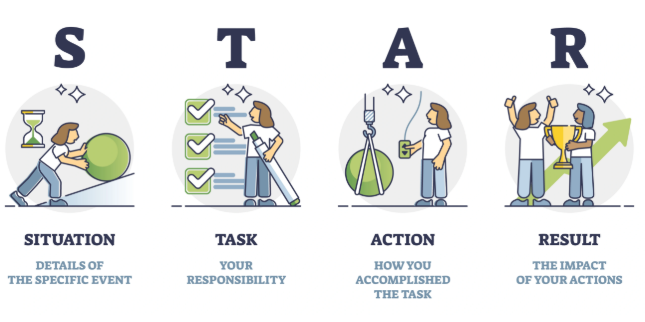
If you’re struggling to turn your responsibilities into strong CV statements, the STAR method can help.
S – Situation: What was happening?
T – Task: What needed to be done?
A – Action: What did you do?
R – Result: What happened as a result?
You don’t need to write out all four sections on your CV. Instead, use the method to identify the achievement and then turn it into a concise statement.
Example
Instead of:
“Responsible for improving delivery routes.”
You could write:
“Redesigned delivery routes for a local courier operation, reducing unnecessary mileage and saving approximately R25,000 in fuel costs over six months.”
The result gives the employer a reason to pay attention.
6. Education, Qualifications & Certifications
List your relevant qualifications, starting with your most recent or highest qualification.
Include:
- Qualification or certification
- Institution
- Year completed, where appropriate
You can also include relevant online courses, professional certifications and workshops.
You don’t necessarily need to list every course you’ve ever completed. Focus on qualifications and training that support the type of work you’re applying for.
7. What About References?
You don’t normally need to use valuable CV space listing the full contact details of your references.
Instead, you can state:
“References available on request.”
Alternatively, if an employer specifically asks for references, provide the requested information.
Always ask someone for permission before using them as a reference, and make sure you have their current contact details.
How Long Should a Professional CV Be?
There is no universal rule that every CV must fit onto one or two pages.
The right length depends on your experience and the position you’re applying for.
A recent graduate or someone entering the workforce may only need one or two pages, while an experienced professional may reasonably need more.
The important thing is relevance.
Don’t add information simply to make your CV longer. At the same time, don’t remove valuable experience just to force an experienced career into a single page.
Ask yourself:
Does this information help demonstrate why I’m suitable for this particular position?
If the answer is no, consider removing it.
Make Your CV ATS Friendly
Many employers use Applicant Tracking Systems (ATS) to help manage large numbers of applications.
An ATS may scan CVs for information such as job titles, qualifications, skills and keywords before a recruiter reviews the application.
You don’t need to create a boring CV to make it ATS-friendly, but simpler formatting is generally safer.
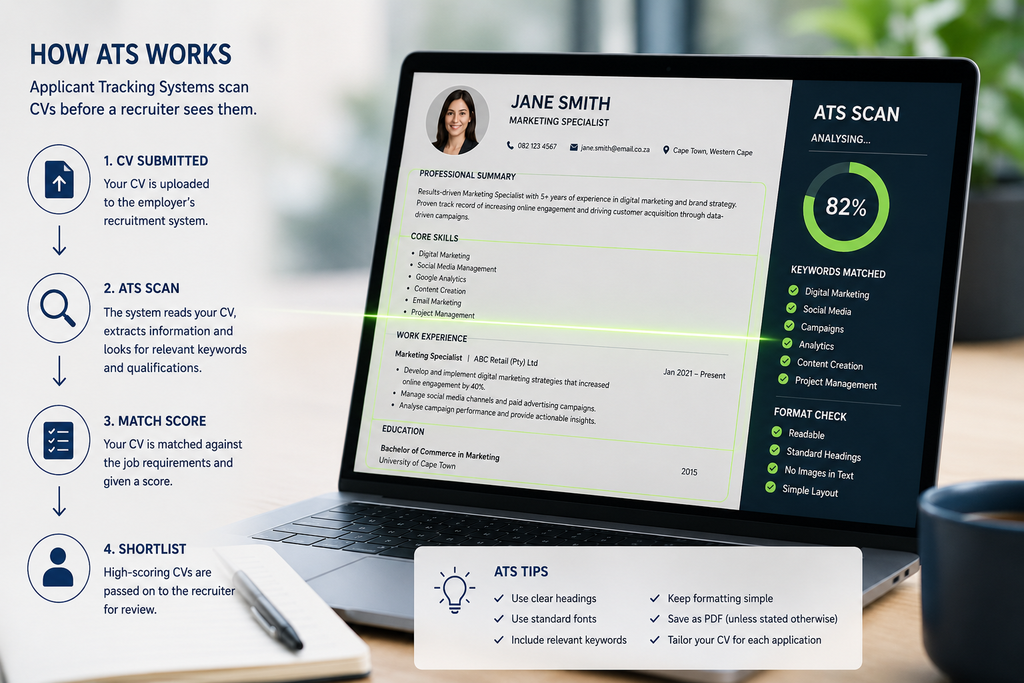
Good practices include:
- Use clear section headings
- Use standard fonts
- Keep your layout consistent
- Use normal text rather than putting important information inside images
- Avoid excessive graphics and decorative elements
- Use keywords that genuinely match your experience
- Follow the employer’s instructions about file type
Most importantly, don’t try to trick an ATS by stuffing your CV with keywords. The content still needs to make sense to the person who eventually reads it.
Tailor Your Professional CV for Every Application
One of the biggest mistakes job seekers make is sending exactly the same CV to every employer.
You don’t necessarily need to rewrite your entire CV for every vacancy, but you should review it before applying.
Look at:
- The job title
- Required skills
- Qualifications
- Experience requirements
- Industry terminology
- Specific responsibilities
Then make sure your most relevant experience and skills are easy to find.
For example, if you’re applying for an administrative position that specifically requires Microsoft Excel, invoicing and stock control, make sure those genuine skills and experiences are clearly visible in your CV.
What Should You Leave Off Your CV?
More information isn’t always better.
Avoid including:
- Irrelevant personal information
- Long paragraphs about every previous job
- Obvious statements such as “references available” taking up excessive space
- Salary expectations unless requested
- Unprofessional email addresses
- Spelling and grammatical errors
- Information that isn’t relevant to the position
- Exaggerated or untrue claims
Be particularly careful about including personal information that isn’t necessary for the application.
If an employer needs additional information for background checks or other screening, they can request it as part of the recruitment process.
Save and Check Your CV Before Sending It
Before submitting your application, take a few minutes to check the final document.
Check your:
- Contact details
Is your phone number correct? Is your email address correct?
- Dates
Do your employment dates and qualifications make sense?
- Spelling and grammar
A simple typo can make an otherwise strong application look careless.
- Formatting
Are headings, fonts, spacing and bullet points consistent?
- File name
Don’t send a document calledCV-final-final-NEW2.pdf.
A professional filename such as:
Jane-Smith-CV.pdf
makes it easier for the recruiter to identify your application.
Check the employer’s instructions
If the vacancy specifically asks for a Word document, application form or another file format, follow those instructions.
Otherwise, use a format that preserves your formatting and is easy for the employer to open.
Your CV Is a Living Document
Don’t wait until you’re desperate for a new job before updating your CV.
Whenever you:
- Learn a new skill
- Complete a qualification
- Take on additional responsibility
- Complete an important project
- Receive an award
- Achieve a measurable result
- Move into a new position
make a note of it.
Keeping your CV updated means you’re far better prepared when an opportunity comes along.
FAQs about How to Write a Professional CV
How long should a CV be in South Africa?
There is no fixed length for a CV. A recent graduate may only need one or two pages, while an experienced professional may need more. Focus on including relevant information rather than trying to meet a specific page count.
Should I include my ID number on my CV?
Generally, there is no need to include your South African ID number on your CV unless an employer specifically requests it. Personal information that isn’t necessary for the initial application is better left off your CV.
Should I include my full home address on my CV?
Usually, your city and province are sufficient. There is generally no need to provide your full street address on a CV.
Should I include a photograph on my CV?
A photograph is not generally necessary unless the employer or vacancy specifically requests one. Your CV should focus on your qualifications, skills and experience.
Should I use a CV template or CV builder?
You can create a professional CV yourself using a simple template, or use an online CV builder if you would like help with formatting and wording. The most important thing is the quality and relevance of your content.
Is PDF the best format for a CV?
PDF can help preserve your formatting when your CV is opened on different devices, but always follow the employer’s instructions. If a vacancy specifically requests a Word document or another format, use the requested format.
How do I make my CV ATS-friendly?
Use clear headings, standard fonts, straightforward formatting and relevant keywords from the job advertisement. Avoid putting important information inside images or using overly complicated layouts
Should I tailor my CV for every job application?
Yes. You don’t need to rewrite your entire CV every time, but you should adjust your professional summary, skills and relevant experience to match the requirements of the particular position.
Should I include references on my CV?
You don’t usually need to include your references’ full contact details unless requested. You can state that references are available on request and provide them when the employer asks.
The Bottom Line
Building a professional CV isn’t about having the most elaborate design or filling every available space.
It’s about making it easy for an employer to understand who you are, what you can do, what you’ve achieved and why you’re relevant to the position.
Take the time to tailor your CV, focus on your achievements and check every detail before you submit it.
Your CV isn’t simply a record of your employment history. It’s your opportunity to show an employer the value you could bring to their organisation.
Other Useful Resources
Learn more about How to Write a Professional Cover Letter to create a good cover letter that complements your CV and shows employers why you’re a strong candidate for the role.
If you’d prefer some help with formatting and creating your CV, explore our recommended Online CV Builders for guided CV creation and professionally designed templates.
And if you’re in a profession where examples of your work can strengthen your application, see our guide to Creating a Professional Online Portfolio.
Affiliate Disclosure
Some of our articles may include links to products, services, or resources that we believe could be helpful to job seekers and employers, some of which are affiliate links, which means we may earn a small commission if you make a purchase, at no extra cost to you. These small commissions help support our editorial team, so we can continue reviewing, testing, and sharing the most useful and effective tools and resources for job seekers.