Last Updated on 03/09/2026 by KLB Editorial Team
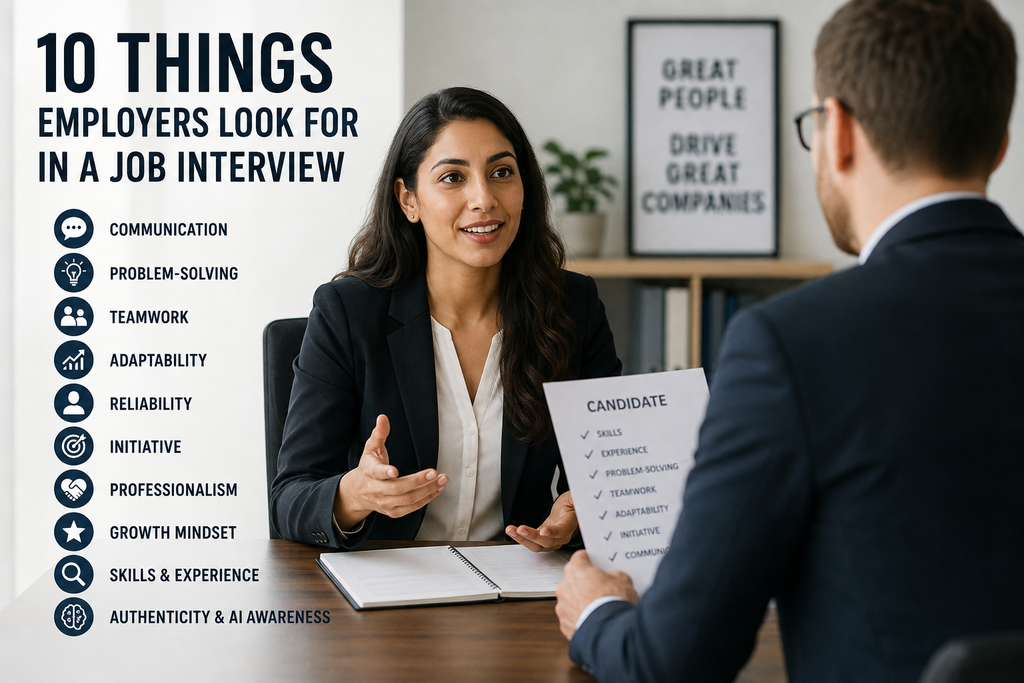
Getting invited to a job interview means your CV has already done part of the work. Now the employer needs to decide whether you can actually do the job, work effectively with others, solve problems and contribute to the organisation.
- 1. The Skills and Experience the Job Actually Requires
- 2. Clear and Effective Communication
- 3. Problem-Solving and Critical Thinking
- 4. Adaptability and Willingness to Learn
- 5. Teamwork and Interpersonal Skills
- 6. Initiative and Ownership
- 7. Reliability and Accountability
- 8. Motivation and Genuine Interest in the Role
- 9. Emotional Maturity and Professionalism
- 10. Authenticity, Independent Thinking and Responsible Use of AI
- Practice What Employers Are Looking For
- What Employers Are Really Trying to Establish in a Job Interview
- How to Show Employers What They Want During an Interview
- Don't Try to Guess the "Perfect" Candidate
- The Bottom Line
- Frequently Asked Questions: Things Employers Look for in a Job Interview
So, what are the things employers look for in a job interview?
While the exact requirements vary by role, industry and company, employers increasingly look beyond qualifications and years of experience. Interviews are often used to assess communication, problem-solving, adaptability, teamwork, motivation, reliability and how you have handled real situations in the past.
In 2026, technical ability still matters, but employers are also placing greater emphasis on the human skills that help people work effectively alongside technology and adapt as jobs continue to change.
Here are 10 things employers commonly look for during a job interview and, more importantly, how you can demonstrate them.
1. The Skills and Experience the Job Actually Requires
The first thing an employer wants to know is fairly straightforward:
Can you do the job?
Your qualifications, previous experience and technical skills should match the requirements of the position. However, simply listing skills on your CV is not enough during an interview. Employers want to hear how you have used those skills in real situations.
For example, instead of saying:
“I have excellent project management skills.”
Explain what you managed, what challenges you faced and what the outcome was.
How to demonstrate this in an interview
- Review the job description carefully before the interview.
- Identify the most important skills and requirements.
- Prepare examples of how you have used those skills.
- Quantify your achievements where possible.
- Be honest about areas where you are still developing.
Don’t try to convince an employer that you are an expert in something you have barely used. A credible answer that shows your actual experience is much stronger than an impressive-sounding claim you cannot support.
2. Clear and Effective Communication
Communication consistently ranks among the skills employers value highly. In an interview, however, you don’t simply tell the interviewer that you are a good communicator. You demonstrate it through the way you answer questions, listen and interact with the interview panel.
Employers may be assessing whether you can:
- Explain your ideas clearly
- Listen carefully to questions
- Give relevant answers without wandering off-topic
- Adjust your communication style when necessary
- Communicate professionally
- Explain complicated information in a way others can understand
How to demonstrate communication skills during an interview
Listen to the entire question before answering. Take a moment to organise your thoughts if necessary, then give a focused response.
If you’re asked a behavioural question, use a real example rather than giving a vague statement about being “a great communicator.”
For example:
Weak:
“I’m a very good communicator and work well with everyone.”
Stronger:
“In my previous role, two departments had different expectations about a project deadline. I arranged a short meeting, clarified what each team needed and agreed on a revised timeline. This allowed us to complete the project without delaying the client.”
Your interview answers themselves are evidence of your communication ability.
3. Problem-Solving and Critical Thinking
Employers don’t expect employees to have an answer for every possible problem. They do want to see how you think when something goes wrong.
Problem-solving interview questions may ask you to describe a difficult situation, explain how you made a decision or talk through how you would approach a hypothetical problem.
These questions help interviewers understand how you gather information, evaluate options and reach a practical decision.
How to demonstrate problem-solving ability
Prepare examples where you:
- Identified a problem
- Investigated what was causing it
- Considered possible solutions
- Took action
- Measured or observed the result
Whenever possible, explain why you chose your particular solution.
That gives the interviewer insight into your reasoning rather than simply showing them the final outcome.
4. Adaptability and Willingness to Learn
Workplaces change constantly. New technology, changing customer expectations, restructuring, new processes and evolving job responsibilities can all require employees to learn and adapt.
Adaptability is therefore becoming increasingly important. The 2026 GMAC Corporate Recruiters Survey lists adaptability among the capabilities employers value highly, alongside communication and problem-solving.
How to demonstrate adaptability
Think about situations where you:
- Learned a new system or technology
- Took on unfamiliar responsibilities
- Adjusted to a change in processes
- Moved into a different role or team
- Had to learn something quickly
- Continued performing effectively during a difficult period
You don’t need to pretend that you love every change.
Instead, demonstrate that when circumstances change, you can learn, adjust and continue moving forward.

5. Teamwork and Interpersonal Skills
Very few jobs exist completely in isolation. Even remote employees usually need to collaborate with colleagues, managers, clients, suppliers or other stakeholders.
Employers therefore want evidence that you can work with different personalities and contribute to a team without creating unnecessary conflict.
How to demonstrate teamwork
Prepare an example that shows how you:
- Worked towards a shared goal
- Supported a colleague
- Resolved a disagreement
- Shared responsibility for a project
- Accepted constructive feedback
- Worked with someone whose approach differed from yours
Don’t make every teamwork example about how you saved the day.
Good teamwork answers show that you understand your own contribution while recognising the contributions of other people.
6. Initiative and Ownership
Employers value people who can take responsibility for their work rather than waiting to be told what to do at every step.
Initiative doesn’t necessarily mean volunteering for every task or working excessive hours. It can be as simple as noticing a problem, suggesting an improvement or taking responsibility for completing something properly.
How to demonstrate initiative
Think of examples where you:
- Identified an opportunity to improve something
- Solved a problem before it became more serious
- Suggested a better process
- Took responsibility for a project
- Learned a skill without being required to do so
- Followed through on a task without constant supervision
Use specific examples. Saying “I’m a self-starter” is far less convincing than describing something you actually initiated.
7. Reliability and Accountability
Employers need people they can trust to do what they say they will do.
Reliability can be difficult to assess from a CV, which is one reason the interview matters. Interviewers may listen for evidence that you take responsibility, meet commitments and deal honestly with mistakes.
How to demonstrate reliability
Prepare an example that shows you:
- Met an important deadline
- Took responsibility for a mistake
- Followed through on a difficult task
- Managed competing priorities
- Kept colleagues or clients informed when something changed
- Delivered consistent results
If you have made a mistake in a previous role, don’t automatically avoid mentioning it.
A strong answer can explain what happened, what you did to correct it and what you learned.
That can demonstrate considerably more maturity than pretending you have never made a mistake.
8. Motivation and Genuine Interest in the Role
You don’t need to perform exaggerated enthusiasm during an interview.
What employers generally want to understand is why you applied for this particular role and whether you have thought seriously about what the job involves.
A candidate who has researched the company and understands the position can usually give a much more convincing answer than someone who simply says:
“I need a job and this position looked interesting.”
How to demonstrate genuine interest
Before the interview, research:
- The company’s products or services
- The responsibilities of the role
- The customers or clients it serves
- Recent developments within the company or industry
- The skills the position requires
Then think about the connection between what the employer needs and what you can contribute.
You should also be prepared to explain why the role makes sense for your experience, interests or career direction.
9. Emotional Maturity and Professionalism
An interview gives employers a glimpse of how you may behave in a professional environment.
They may pay attention to how you respond when you don’t immediately know an answer, how you talk about previous employers and colleagues, and whether you can discuss difficult situations without becoming defensive or blaming everyone else.
Professionalism can include:
- Respectful communication
- Self-awareness
- Appropriate confidence
- Listening
- Handling disagreement constructively
- Responding well to feedback
- Remaining composed under pressure
How to demonstrate professionalism
Be honest when you don’t know something.
For example:
“I haven’t worked with that particular system yet, but I have used similar software and I’m confident I could learn it quickly.”
That’s much stronger than pretending to have experience you don’t have.
Similarly, when discussing a difficult previous workplace, focus on the situation and what you learned rather than turning your answer into a complaint session.
10. Authenticity, Independent Thinking and Responsible Use of AI
There is a new wrinkle in interviews that candidates cannot really ignore in 2026.
AI can help job seekers research companies, improve CVs and practise interview questions. Employers are increasingly using AI throughout recruitment too. At the same time, recruiters are becoming more concerned about candidates submitting highly polished AI-generated applications or relying on AI to produce answers they cannot genuinely support.
That makes authenticity and independent thinking increasingly valuable.
An interviewer may want to know whether the experiences you describe are genuinely yours and whether you can think through a problem without simply producing a rehearsed response.
How to demonstrate authenticity
- Use real examples from your experience.
- Don’t memorise entire interview answers word-for-word.
- Use AI to prepare, but make sure you understand and can discuss everything in your application.
- Don’t exaggerate your qualifications or experience.
- Be prepared to explain how you reached a decision.
- Give specific details that demonstrate firsthand experience.
AI can help you prepare for an interview. It cannot replace the experience behind your answers.
Practice What Employers Are Looking For
Knowing what employers look for is one thing. Being able to demonstrate those qualities naturally when you’re sitting in front of an interviewer is another.
That’s why practice matters.
Instead of simply reading lists of common interview questions, practise answering them out loud. This helps you identify where your answers are too long, where you are relying on vague statements and which examples you need to strengthen.
AI interview practice tools can make this easier by giving you a realistic interviewer to practise with and feedback you can use to improve.
Huru.ai: Practise Your Interview Skills
Huru.ai is designed for candidates who want to practise interviews repeatedly and receive immediate feedback. You can use AI-powered mock interviews to work on areas such as communication, answer structure, confidence and delivery.
It’s particularly useful if you want to practise behavioural and general interview questions without having to find a friend or colleague who is willing to conduct another mock interview.
Try Huru.ai if you want to:
- Practise answering questions out loud
- Work on your communication and delivery
- Get feedback after your answers
- Repeat interviews until you feel more comfortable
- Prepare for behavioural and role-specific questions
👉 Try Huru.ai Interview Practice
Final Round AI: Practice for a Specific Interview
If you’re preparing for a particular job, Final Round AI takes a more role-focused approach. Its Practice Interview feature lets you rehearse aloud with an AI interviewer using the job context, resume and other materials you’ve prepared for that role. You can choose different interview scenarios and review a debrief after your practice session.
Final Round AI may be particularly useful if you want to:
- Practice for a specific role or company
- Rehearse behavioural, technical or other interview formats
- Answer questions aloud in a realistic interview setting
- Review feedback after a practice session
- Identify weaker areas and practice them again
👉 Try Final Round AI Practice Interview
Which One Should You Use?
Both platforms can help you practise, but your choice may depend on what you’re trying to improve.
Choose Huru.ai if your priority is repeated general interview practice, communication, confidence and feedback.
Choose Final Round AI if you want practice built around a specific job, resume and interview scenario.
Whichever tool you choose, don’t use AI to write perfect answers that you simply memorise. Use it to practice thinking, speaking and responding under interview conditions. The goal is to become better at communicating your own experience, not to sound like a chatbot wearing a suit.
What Employers Are Really Trying to Establish in a Job Interview
Although the exact interview questions vary from one employer to another, many interviews are ultimately trying to answer a few fundamental questions:
Can you do the job?
Your qualifications, experience, technical knowledge and examples of previous achievements help answer this question.
Can you solve problems?
Employers want to understand how you approach challenges, make decisions and deal with unexpected situations.
Can you work effectively with other people?
Your communication, teamwork and interpersonal skills matter in almost every workplace.
Can you adapt?
Employers need people who can learn new skills and respond when circumstances change.
Can they trust you?
Reliability, accountability, professionalism and honesty all contribute to the employer’s confidence in hiring you.
Do you actually want this role?
Employers don’t necessarily expect candidates to be passionate about every aspect of a job. They do want evidence that you understand the position and have a genuine reason for wanting it.
How to Show Employers What They Want During an Interview
One of the biggest mistakes candidates make is listing qualities instead of demonstrating them.
Anyone can say:
“I’m adaptable, hardworking, organised and a great problem-solver.”
The interviewer still has no evidence.
Instead, use specific examples from your experience.
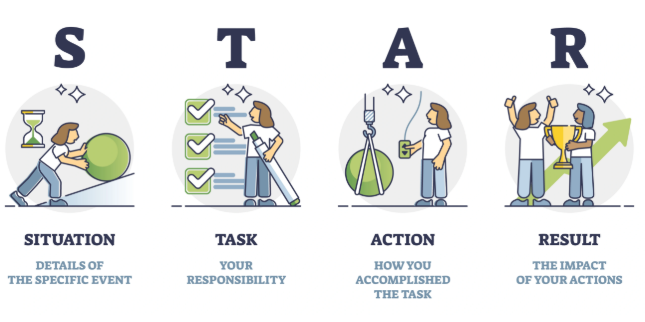
A useful structure for behavioural interview questions is the STAR method:
Situation: What was happening?
Task: What were you responsible for?
Action: What did you actually do?
Result: What happened as a result?
For example, if an employer asks:
“Tell me about a time you had to solve a difficult problem.”
Don’t spend two minutes explaining that you are naturally good at problem-solving.
Tell them what the problem was, what you did, why you chose that approach and what happened afterwards.
That gives the interviewer something they can actually evaluate.
Don’t Try to Guess the “Perfect” Candidate
It’s tempting to read lists like this and think you need to convince an employer that you possess every desirable personality trait.
You don’t.
The best approach is to understand what the specific job requires and prepare evidence that demonstrates your suitability.
A sales position may place considerable emphasis on communication, persuasion and relationship-building. A technical role may focus more heavily on technical competence, analytical thinking and problem-solving. A management position may place greater weight on leadership, decision-making and conflict resolution.
The job description is therefore one of your most useful interview-preparation tools.
Read it carefully and ask yourself:
“What evidence can I give that I can do these things?”
The Bottom Line
The things employers look for in a job interview are not limited to qualifications or years of experience.
They want evidence that you can do the work, communicate effectively, solve problems, adapt to change, work with others and take responsibility for your results.
In 2026, candidates also need to be prepared to demonstrate something increasingly difficult to fake: genuine experience, independent thinking and the ability to use AI responsibly rather than allowing it to speak for them.
Before your next interview, don’t just rehearse answers to common questions.
Review the job description, identify the skills the employer is likely to assess and prepare several real examples from your experience. The goal isn’t to sound perfect. It’s to give the interviewer enough evidence to understand how you could perform in the role.
Frequently Asked Questions: Things Employers Look for in a Job Interview
What are the top things employers look for in a job interview?
Employers commonly look for evidence that a candidate can do the job, communicate effectively, solve problems, work well with others and adapt to changing circumstances. They may also assess reliability, initiative, professionalism, motivation and the ability to learn. The specific qualities employers prioritise will depend on the role and industry.
What skills do employers look for in candidates?
Commonly valued skills include communication, problem-solving, adaptability, teamwork, critical thinking, initiative and technical competence. Employers may also look for digital skills and the ability to work effectively with new technologies, including AI tools.
How do I show employers that I am a good candidate?
The best way is to provide specific examples from your experience rather than simply listing positive qualities. Explain what situation you faced, what you were responsible for, what action you took and what happened as a result. The STAR method can be particularly useful for answering behavioural interview questions.
Do employers care about personality in an interview?
Yes, but employers are generally more interested in how your behaviour and working style relate to the requirements of the role than whether you have a particular personality. Communication, professionalism, teamwork, self-awareness and the ability to handle feedback can all provide useful insight into how you may work with others.
What should I say when an interviewer asks why they should hire me?
Focus on the value you can bring to the specific role. Briefly connect your relevant skills, experience and achievements to what the employer needs. Avoid simply saying that you are hardworking or passionate. Give one or two specific examples that demonstrate why you are well suited to the position.
Do employers look for AI skills in job interviews in 2026?
Increasingly, yes. The importance of AI-related skills varies by role, but employers are becoming more interested in candidates who can use AI and other technology appropriately while still demonstrating human skills such as communication, critical thinking, problem-solving and independent judgement. Candidates should be prepared to explain how they use AI responsibly rather than relying on it to replace their own expertise.
Need more help preparing for your next interview? Explore our full guide with Interview Preparation Tips for practical strategies and common interview questions or visit our Interview Tips & Tools page for useful practice tools to help you prepare better.
Aced the interview and received the job offer? Read our article on Better Salary Negotiation Tips.
Other Helpful Related Resources
Affiliate Disclosure
Some of our articles may include links to products, services, or resources that we believe could be helpful to job seekers and employers, some of which are affiliate links, which means we may earn a small commission if you make a purchase, at no extra cost to you. These small commissions help support our editorial team, so we can continue reviewing, testing, and sharing the most useful and effective tools and resources for job seekers.