
Last Updated on 03/09/2026 by KLB Editorial Team
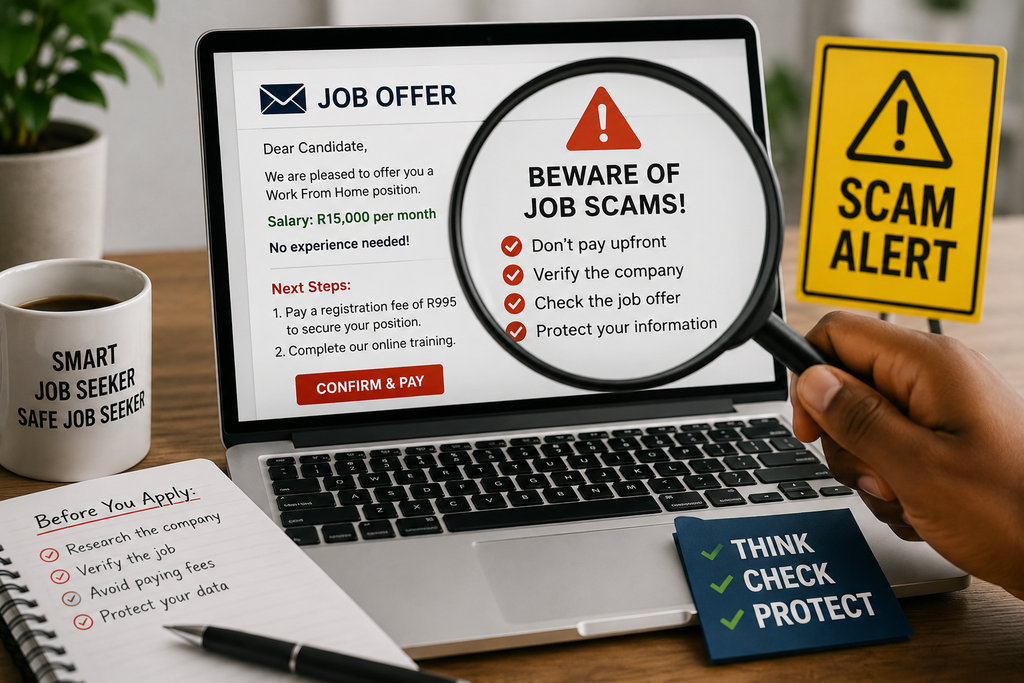
Finding a job can be stressful enough without having to worry about whether the opportunity in front of you is even real.
Unfortunately, fake job offers are common on social media, WhatsApp, job websites and even through messages that appear to come from legitimate companies or government departments.
The good news is that most job scams have warning signs.
Table of Contents
The Golden Rule: Never Pay to Get a Job
If someone asks you to pay money to secure a job, get shortlisted, register as a candidate, complete a background check or receive your salary, stop and investigate before doing anything else.
In South Africa, the Department of Employment and Labour warns that work seekers should not be charged fees for employment services. Private employment agencies are also prohibited from charging work seekers for placement.
Scammers may describe the payment as a:
- Registration fee
- Application fee
- Recruitment fee
- Background-check fee
- Training fee
- “Refundable” deposit
- Administration fee
- Starter kit
Calling it refundable does not make it legitimate.
⚠️ 15 Red Flags of a Fake Job Offer
One warning sign does not automatically prove that a job is fake. However, several of these signs appearing together should make you extremely cautious.
1. You are asked to pay money
This is one of the biggest red flags.
A supposed employer or recruiter should not ask you to pay money simply to obtain employment. South African government departments have repeatedly warned about scams requesting “refundable” payments for supposed job opportunities.
2. You receive a job offer you never applied for
Be careful if someone suddenly contacts you claiming that your CV was selected for a position you don’t remember applying for.
Scammers may say they found your CV online to make the approach sound legitimate.
3. The offer promises unusually high pay for very little work
“Earn R10,000 a week from home with no experience” may sound tempting, but unusually generous promises deserve scrutiny.
Ask yourself whether the salary, duties and requirements make sense for the position.
4. You are pressured to act immediately
Scammers don’t want you to have time to investigate.
Watch out for messages such as:
- “Only five positions left.”
- “Pay today to secure your place.”
- “You must respond within one hour.”
- “Your application will be cancelled if you don’t pay now.”
A legitimate employer should not need to rush you into handing over money or sensitive information.
5. The recruiter only wants to communicate through WhatsApp or Telegram
WhatsApp itself is not a scam, and legitimate recruiters may sometimes use messaging platforms.
However, be cautious when the entire recruitment process takes place through a personal number or messaging app, particularly when there is no way to independently verify the recruiter or company.
6. The email address doesn’t match the company
Look carefully at the email address.
A recruiter claiming to represent a major company should normally be able to communicate through an official company domain.
Be particularly careful with addresses that use free email services or domains that are designed to look almost identical to the real company.
7. The job isn’t listed on the company’s official website
If someone sends you a job advert for a well-known company, go directly to that company’s official website and search for the vacancy yourself.
Don’t rely on the link supplied by the recruiter.
South African organisations have repeatedly warned about fake vacancies circulating on WhatsApp and social media that impersonate real employers and government institutions.
8. You are asked for sensitive information too early
A legitimate employer may eventually need information such as your ID details or banking information for legitimate employment and payroll purposes.
But be extremely cautious if a stranger asks for sensitive information before you have even had a proper interview or verified the company.
Never send passwords, PINs or banking login details to a recruiter.
9. The job description is vague
Be wary of advertisements that say things like:
“Easy online work. Earn from home. No experience required. Contact us for details.”
A legitimate job advertisement should normally provide enough information for you to understand the role, employer, responsibilities and basic requirements.
10. The recruiter has a suspicious social media profile
A professional-looking LinkedIn or Facebook profile does not prove that someone is a genuine recruiter.
Check whether the person’s employment history makes sense, whether they have a genuine connection to the company and whether you can verify them independently.
Scammers can create convincing profiles and use stolen photographs or company branding.
11. You receive a suspicious employment contract or appointment letter
Fake job offers can include professional-looking contracts, logos, signatures and even the names of real employees.
Don’t assume a document is genuine simply because it looks official.
Government departments have warned about fraudulent employment letters using official logos and requesting payments for supposed background checks.
12. You’re told to deposit a cheque and send money back
This is a classic employment scam.
The scammer may send you a cheque or payment and then tell you to transfer part of the money to another person or purchase equipment or supplies.
The original payment may later be reversed, leaving you responsible for the money you sent.
13. You’re offered a job involving reshipping packages
Be extremely cautious if a supposed employer asks you to receive packages at home and then forward them to another address.
These schemes can involve goods purchased using stolen payment details, potentially putting you at serious legal risk even if you did not realise what was happening.
14. An overseas job offer seems too good to be true
Be especially careful with international job offers promising high salaries, free flights and accommodation with very few requirements.
This is more than a financial scam risk. In July 2026, South Africa’s Department of Social Development warned that fake overseas job offers have been used to lure South Africans into human trafficking and forced criminal activity.
Research the employer and recruitment agency independently, verify the job and discuss the opportunity with someone you trust before travelling.
15. Everything looks professional, but something still feels wrong
This is an important one.
A scam does not have to contain spelling mistakes or look obviously fake.
Modern scammers can create convincing websites, emails, social media profiles, documents and messages.
Professional-looking does not necessarily mean legitimate.
How to Check a Job Before You Apply
Before sending personal information or accepting an offer, take a few minutes to investigate.
Check the employer
Search for the company’s official website yourself rather than relying on a link sent by the recruiter.
Look for:
- An established company website
- A physical business presence where appropriate
- Official contact details
- A careers or vacancies page
- Consistent company information across different sources
Check the vacancy
If the company has an official careers page, see whether the position appears there.
If it doesn’t, contact the company through contact details obtained independently and ask whether the vacancy is genuine.
Check the recruiter
Search for the recruiter’s name and professional history.
If they claim to work for a company, contact that company directly using its official website or published contact details.
Never let a scammer choose how you verify them
This is one of the easiest rules to remember.
If a recruiter gives you a phone number, email address or website and tells you to use it to “verify” the job, don’t rely on that information alone.
Find the company’s official contact details yourself.
What If You’ve Already Been Scammed?
Don’t panic, but act quickly.
If you have already sent money or personal information:
- Stop communicating with the scammer.
- Contact your bank immediately if you shared banking information or transferred money.
- Save evidence, including messages, emails, phone numbers, payment confirmations and screenshots.
- Report the scam to the relevant platform.
- Report employment-related scams to the Department of Employment and Labour and consider reporting fraud to the police.
- If you suspect human trafficking or exploitation, contact SAPS on 10111 or the Gender-Based Violence Command Centre on 0800 428 428.
The sooner you act, the better.
Finding Legitimate Job Opportunities
Being careful about scams doesn’t mean you should avoid online job searching.
It means learning how to distinguish a genuine opportunity from a suspicious one.
Use reputable job boards, check vacancies against the employer’s official website and research companies before sending sensitive information.
You can also explore our Job Search Sites page for reputable places to look for employment opportunities, along with our guides on CVs, cover letters, interview preparation and job-search tools.
The Bottom Line
Job scams work because scammers know how badly people need employment. They may use genuine company names, professional-looking documents and convincing messages to make a fake opportunity look real.
Don’t let excitement or pressure make the decision for you.
If someone asks you to pay for a job, stop. If an offer seems unusually good, investigate it. If you’re asked for sensitive information too early, step back.
A few minutes of research could save you money, your personal information and potentially much more.
At KLB Recruitment, we want you to find real opportunities without falling into the traps waiting for job seekers online.
Frequently Asked Questions: How to Spot a Fake Job Offer
How can I tell if a job offer is real?
Check the employer independently before responding or providing personal information. Look for the vacancy on the company’s official website, verify the recruiter’s identity and use contact details you find yourself rather than those provided in a suspicious message.
Do legitimate employers ask you to pay for a job?
Generally, no. You should be extremely cautious if you are asked to pay a registration, recruitment, training, background-check or placement fee to get a job. South Africa’s Department of Employment and Labour warns work seekers about employment scams involving upfront payments.
Are WhatsApp job offers always scams?
No. Some legitimate recruiters use WhatsApp to communicate with candidates. However, a WhatsApp-only recruitment process should be treated cautiously if the recruiter cannot be independently verified, the job cannot be found on the company’s official website or you are asked to pay money.
Can scammers use real company names?
Yes. Scammers may impersonate genuine companies, recruiters or government departments and use real logos, employee names and company information to make a fake job offer look convincing. Always verify the opportunity through the organisation’s official channels.
Should I send my ID when applying for a job?
An employer may legitimately need identification documents during a recruitment or onboarding process, but you should not automatically send sensitive documents to an unverified recruiter. First confirm who you are dealing with and why the information is required.
What should I do if a recruiter asks for my banking details?
Do not provide banking passwords, PINs, online-banking login information or one-time passwords. If banking information is requested unusually early in the recruitment process, verify the employer independently before providing anything.
What if I have already paid a job scammer?
Contact your bank immediately if you transferred money or shared financial information. Save all messages, emails, phone numbers, payment records and other evidence, and report the scam to the relevant authorities and platform.
Are fake work-from-home jobs common?
Work-from-home scams can be particularly attractive because they often promise flexible hours, high earnings and no experience required. Be cautious when a remote job requires an upfront payment, involves receiving and reshipping packages, or promises unusually high earnings for very little work.
Can a job scam happen on LinkedIn?
Yes. Being contacted through a professional platform does not automatically make a job offer legitimate. Scammers can create convincing recruiter profiles and impersonate real companies. Verify the vacancy and recruiter independently before proceeding.
What is the biggest warning sign of a job scam?
Being asked to pay money to obtain employment is one of the biggest red flags. Other major warning signs include pressure to act immediately, unverifiable recruiters, suspicious email addresses, vague job descriptions and requests for sensitive information before the employer has been properly verified.
Where can I find legitimate job opportunities in South Africa?
Use reputable job boards and recruitment websites, and whenever possible check vacancies against the employer’s own careers page. You can also explore KLB Recruitment’s Job Search Sites page for resources to help you search for legitimate employment opportunities.