Last Updated on 03/09/2026 by KLB Editorial Team

If you’ve been invited to an AI interview, you’re probably wondering what to expect.
Will you be speaking to a chatbot? Will you record video answers? Is artificial intelligence actually judging your facial expressions? And, most importantly, how can you make sure you give yourself the best chance of moving to the next stage?
AI is becoming increasingly common in recruitment. Employers may use artificial intelligence to screen applications, conduct initial interviews, assess responses or help recruiters manage large numbers of candidates.
The good news is that you don’t need to learn how to “beat” an AI system.
You need to understand what type of interview you’re taking, prepare your answers properly and make sure your technology and communication don’t get in the way of demonstrating your suitability for the job.
- What Is an AI Interview?
- How Does AI Fit Into the Recruitment Process?
- How to Pass an AI Interview
- Can AI Interviews Detect If You're Reading Answers?
- What Should You Wear for an AI Video Interview?
- What If You Get Nervous During an AI Interview?
- Common AI Interview Questions
- How to Practice for an AI Interview
- What Not to Do in an AI Interview
- The Bottom Line on How to Pass an AI Interview
- More Interview Preparation Resources
- Frequently Asked Questions About AI Interviews
What Is an AI Interview?
An AI interview is a recruitment interview or assessment that uses artificial intelligence as part of the process.
The exact format varies between employers and recruitment platforms.
You may encounter:
- Pre-recorded video interviews where you answer questions on camera
- AI-powered interview platforms that analyse or organise your responses
- Chatbot interviews where you respond to questions in text
- Automated assessments designed to evaluate specific skills
- AI-assisted screening that helps recruiters identify candidates for further consideration
Not every AI interview works in the same way, and you should not assume that every system analyses your facial expressions, eye movements or personality.
What matters is understanding the format you’re being asked to complete and preparing accordingly.
How Does AI Fit Into the Recruitment Process?
AI can appear at several stages of the hiring process.
1. CV Screening
Many employers use Applicant Tracking Systems (ATS) to help manage applications.
An ATS may identify information such as:
- Relevant skills
- Job titles
- Qualifications
- Work experience
- Keywords related to the vacancy
This is why your CV should clearly reflect the experience and skills that are genuinely relevant to the position.
Don’t stuff your CV with keywords. Instead, read the job description carefully and make sure your relevant qualifications, skills and experience are clearly described.
2. Initial Interviews
Some employers use automated or AI-assisted interviews to conduct an initial screening before candidates speak with a recruiter or hiring manager.
You may be asked the same types of questions you would encounter in a traditional interview, such as:
- Tell me about yourself.
- Why are you interested in this position?
- Why do you want to work for our company?
- What are your strengths?
- Tell me about a difficult situation you handled.
- Describe a time when you solved a problem.
3. AI-Assisted Assessment
Some recruitment systems can help employers organise or assess large volumes of candidate information.
The exact technology and criteria vary considerably between companies.
The safest approach is not to try to predict an algorithm. Focus on giving clear, relevant and honest answers that demonstrate why you are suitable for the role.
How to Pass an AI Interview
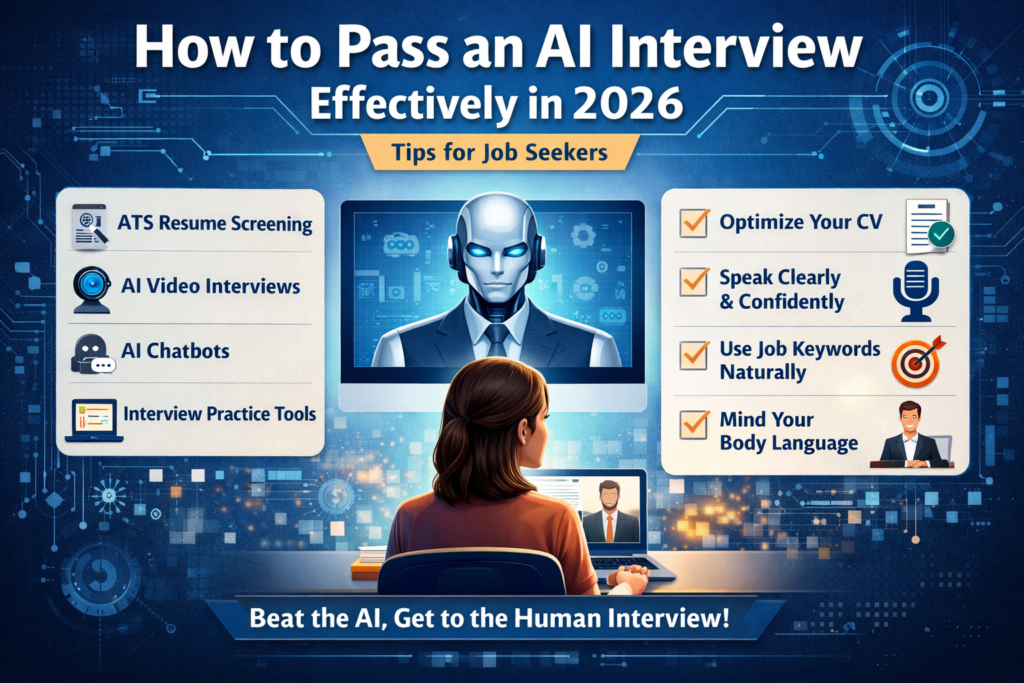
Whether you’re completing a recorded video interview or another type of AI-assisted interview, these steps can help you prepare.
1. Read the Job Description Carefully
Your first preparation step should be the same as it would be for any interview: understand the job.
Look at the:
- Required skills
- Responsibilities
- Qualifications
- Experience requirements
- Key competencies
- Company values
Think of examples from your own experience that demonstrate the abilities the employer is looking for.
This will help you give specific answers instead of generic responses.
2. Prepare Key Talking Points, Not a Script
One of the biggest mistakes you can make is trying to memorise every answer word-for-word.
Instead, prepare a few key points for the questions you’re most likely to encounter.
For example, if you’re asked:
“Tell me about a time you dealt with a difficult customer.”
… prepare the situation, what you did and the outcome.
This allows you to sound prepared without sounding rehearsed.
3. Use the STAR Method for Competency Questions
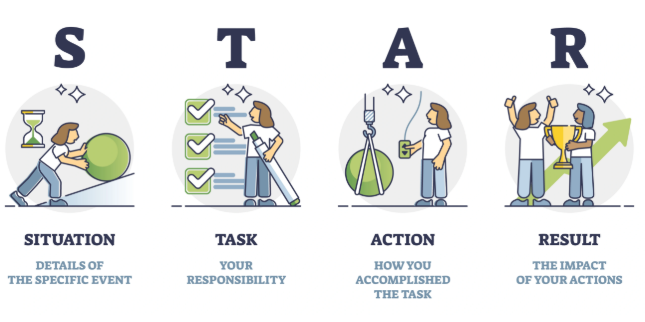
The STAR method is particularly useful for behavioural and competency-based questions.
S – Situation: Explain the circumstances.
T – Task: Describe what you needed to achieve.
A – Action: Explain what you personally did.
R – Result: Describe the outcome.
For example, don’t simply say:
“I’m good at solving problems.”
Give the interviewer an example that demonstrates your problem-solving ability.
Where possible, include measurable results.
4. Use Relevant Job-Specific Language Naturally
Review the terminology used in the job advertisement and make sure your answers clearly demonstrate the relevant skills.
For example, if the position requires stakeholder management, don’t be afraid to use that phrase when describing genuine experience you have in that area.
However, don’t force keywords into your answers.
Your objective is to demonstrate that you understand the role and have relevant experience, not to produce a list of buzzwords.
5. Test Your Camera, Microphone and Internet Connection
If you’re completing a video interview, technical preparation matters.
Before starting:
- Test your microphone
- Check your camera
- Make sure your internet connection is reliable
- Position your camera around eye level
- Make sure your face is well lit
- Choose a quiet location
- Remove distracting objects from the background
- Close unnecessary programs and browser tabs
If the platform allows a practice question, use it.
A technical problem can make an already stressful interview considerably harder.
6. Look at the Camera When Speaking
If you’re completing a video interview, try to look toward the camera when giving your answers.
This creates the impression of eye contact for the person watching the recording later.
You don’t need to stare rigidly into the lens for the entire interview. Natural movement is fine.
The goal is simply to avoid spending the entire interview looking down at your notes or watching your own image on screen.
7. Speak Clearly and at a Comfortable Pace
You don’t need to speak like a newsreader.
Simply aim to:
- Speak clearly
- Avoid rushing
- Pause briefly when you need to think
- Keep your answers focused
- Reduce unnecessary filler words
- Use a confident, conversational tone
If you make a small mistake, don’t panic.
Pause, correct yourself and continue.
8. Keep Your Answers Relevant
One of the easiest ways to weaken an interview answer is to talk for too long without actually answering the question.
Before you start speaking, take a moment to understand what the question is asking.
Then answer it directly.
For behavioural questions, the STAR method can help you keep your response structured without turning it into a long story.
9. Be Yourself
Don’t try to create an artificial “perfect candidate” persona.
Your answers should sound professional, but they should still sound like you.
Avoid:
- Overly complicated language
- Memorised speeches
- Generic corporate buzzwords
- Answers generated by AI that you don’t fully understand
- Pretending to have experience you don’t have
Recruiters are ultimately looking for a person who can do the job and communicate effectively, not someone who has memorised the world’s most impressive collection of interview phrases.
Can AI Interviews Detect If You’re Reading Answers?
This depends entirely on the platform and how the employer has configured the interview.
Some systems may monitor behaviour or identify patterns that could indicate unusual activity, while others may simply record your responses for later review.
Rather than trying to work out exactly what a particular system can detect, the better strategy is to prepare thoroughly enough that you don’t need to read a script.
Keep a few brief notes nearby if the interview format permits it, but don’t rely on a full written answer.
Your responses will generally sound much more natural when you’re explaining your own experience rather than reading someone else’s words.
What Should You Wear for an AI Video Interview?
Treat an AI video interview as a real interview.
Choose professional clothing that is appropriate for the position and company.
You don’t necessarily need to wear formal business attire for every role. A technology start-up may have a very different dress culture from a corporate law firm, for example.
When you’re unsure, it’s generally safer to look neat, professional and well-presented.
Remember that your interview may eventually be viewed by a human recruiter or hiring manager.
What If You Get Nervous During an AI Interview?
Being nervous doesn’t mean you’re going to fail.
In fact, knowing that you’re speaking to a computer can make an interview feel even stranger.
Try these techniques:
Take a short pause before answering
You don’t have to respond instantly. Take a moment to collect your thoughts.
Practise speaking aloud
Reading interview questions silently isn’t the same as answering them.
Record yourself answering questions and listen back to identify areas where you rush, ramble or lose your train of thought.
Prepare examples in advance
Think about several situations from your career that demonstrate skills such as:
- Problem-solving
- Teamwork
- Leadership
- Communication
- Conflict resolution
- Adaptability
- Meeting deadlines
You can adapt these examples to many different interview questions.
Common AI Interview Questions
Many AI-assisted interviews use questions that are similar to traditional job interviews.
Prepare for questions such as:
“Tell me about yourself.”
Keep your answer professional and relevant to the role.
Briefly explain your experience, key strengths and why the position interests you.
“Why do you want this job?”
Show that you’ve researched the organisation and understand what the position involves.
“Why should we hire you?”
Connect your strongest relevant skills and experience to what the employer needs.
“Tell me about a challenge you faced.”
Use the STAR method to explain the situation, your actions and the result.
“Tell me about a time you made a mistake.”
Be honest. Explain what happened, what you learned and what you changed as a result.
“Where do you see yourself in five years?”
Focus on realistic professional development and how the role fits into your longer-term career goals.
How to Practice for an AI Interview
Should You Use AI to Prepare for an AI Interview?
Absolutely. AI can be a useful practice partner before your interview, particularly if you don’t have someone available to conduct mock interviews with you.
The key is to use AI to practice and improve your own answers, rather than relying on it to answer questions for you during the real interview.
Practice With an AI Mock Interview Tool
Tools such as Huru.ai are designed specifically for interview preparation. You can practise realistic mock interviews, prepare for specific roles and receive AI feedback on your answers, delivery and confidence. Huru also allows you to upload a job posting or create an interview based on a position you’re applying for, making your practice more relevant to the actual role.
👉 Practice your next interview with Huru.ai
Another option is Final Round AI, which offers AI-led Practice Interviews where you answer questions aloud in a realistic back-and-forth with an AI interviewer. You can practise different interview formats, including general, behavioural, coding, system design, product, case, data and recruiter interviews. Its practice sessions can also be connected to a specific job, using your resume and other preparation materials to make the questions more relevant.
👉 Try Final Round AI’s Practice Interview
Whichever tool you choose, don’t try to memorise the answers it gives you. Use the feedback to identify where you need to improve, then practice answering in your own words.
What Not to Do in an AI Interview
Avoid these common mistakes:
Don’t read a complete script. It can make your answers sound unnatural and may not be permitted by the employer.
Don’t keyword-stuff your answers. Mention relevant skills naturally when you have genuine experience.
Don’t stare constantly at your own image. Look toward the camera when speaking.
Don’t ignore technical problems. Test everything before the interview starts.
Don’t use AI-generated answers that aren’t yours. If you don’t understand or couldn’t explain an answer yourself, don’t use it.
Don’t assume AI is making the final hiring decision. In many recruitment processes, AI is one component of a larger process involving recruiters and hiring managers.
The Bottom Line on How to Pass an AI Interview
An AI interview is still a job interview.
The technology may change how the interview is delivered or how information is processed, but the fundamentals remain familiar.
Understand the job. Prepare relevant examples. Structure your answers. Speak clearly. Test your technology. And be yourself.
Don’t waste your preparation time trying to discover secret tricks for manipulating an algorithm.
Instead, make it easy for the employer to see that you have the skills, experience and communication abilities required for the role.
And remember that an AI interview is often only one stage of the recruitment process. If you progress, you may still need to impress a recruiter or hiring manager in a traditional interview.
At KLB Recruitment, we’re here to help you navigate every stage of your job search.
More Interview Preparation Resources
Looking for more interview advice and useful interview preparation tools?
Visit our Interview Tips & Tools page for additional resources or read our full Interview Preparation Guide for more practical job interview tips and advice.
Read our article on the Things Employers Commonly Look for During an Interview and how to demonstrate them to give yourself an edge when preparing for job interviews.
Frequently Asked Questions About AI Interviews
What is an AI interview?
An AI interview is a job interview or assessment that uses artificial intelligence as part of the recruitment process. It may involve recorded video questions, chat-based interviews, automated assessments or AI-assisted evaluation.
How do you pass an AI interview?
Prepare in the same way you would for a traditional interview. Understand the job description, prepare relevant examples, practise answering questions aloud, speak clearly and make sure your camera, microphone and internet connection work properly.
Do AI interviews watch you?
Some video interview platforms may analyse aspects of a candidate’s video or audio, while others may simply record responses for later review. The technology varies between platforms and employers, so you should not assume that every AI interview analyses facial expressions or body language.
Can AI interviews detect if you’re reading answers?
Some interview systems may have features designed to identify unusual behaviour, but this varies by platform. The safest approach is to prepare talking points rather than reading a complete script.
Are AI interviews used in South Africa?
AI-assisted recruitment technology is available to employers in South Africa, and South African candidates may also encounter AI interviews when applying for international or remote positions.
What are the most common AI interview questions?
Common questions include “Tell me about yourself”, “Why do you want this job?”, “Why should we hire you?”, and behavioural questions asking you to describe situations in which you demonstrated particular skills.
How can I practice for an AI interview?
Record yourself answering common interview questions, practice using the STAR method and use AI interview tools to generate questions and provide feedback. The more familiar you are with speaking about your experience, the easier it becomes to answer naturally.
Do AI interviews replace human interviews?
Not necessarily. AI may be used to support or automate parts of the recruitment process, but many employers still involve recruiters and hiring managers when making hiring decisions.
Affiliate Disclosure
Some of our articles may include links to products, services, or resources that we believe could be helpful to job seekers and employers, some of which are affiliate links, which means we may earn a small commission if you make a purchase, at no extra cost to you. These small commissions help support our editorial team, so we can continue reviewing, testing, and sharing the most useful and effective tools and resources for job seekers.